The Clarity Act had the backing of BlackRock, Fidelity, Goldman Sachs, and most of Wall Street this week. The Senate shelved it anyway, prioritising federal nominees and a Russia-Iran sanctions bill, pushing prediction market odds of passage to 34% and the next realistic window to September at the earliest. While that played out, the Fed prepared for one of its most uncertain meetings in years, Bitcoin quietly posted a 6% monthly gain while semiconductor stocks fell nearly 20%, Morgan Stanley launched Ethereum and Solana ETPs, Ondo Finance abandoned its blockchain plans and reinvented itself entirely, and a brewery on the NSW Central Coast figured out how to mine Bitcoin with its rooftop solar and use the heat to make beer. A week of frustration at the top and genuine momentum underneath it. Let's get into it.
The Clarity Act Misses Its Window. Now What?
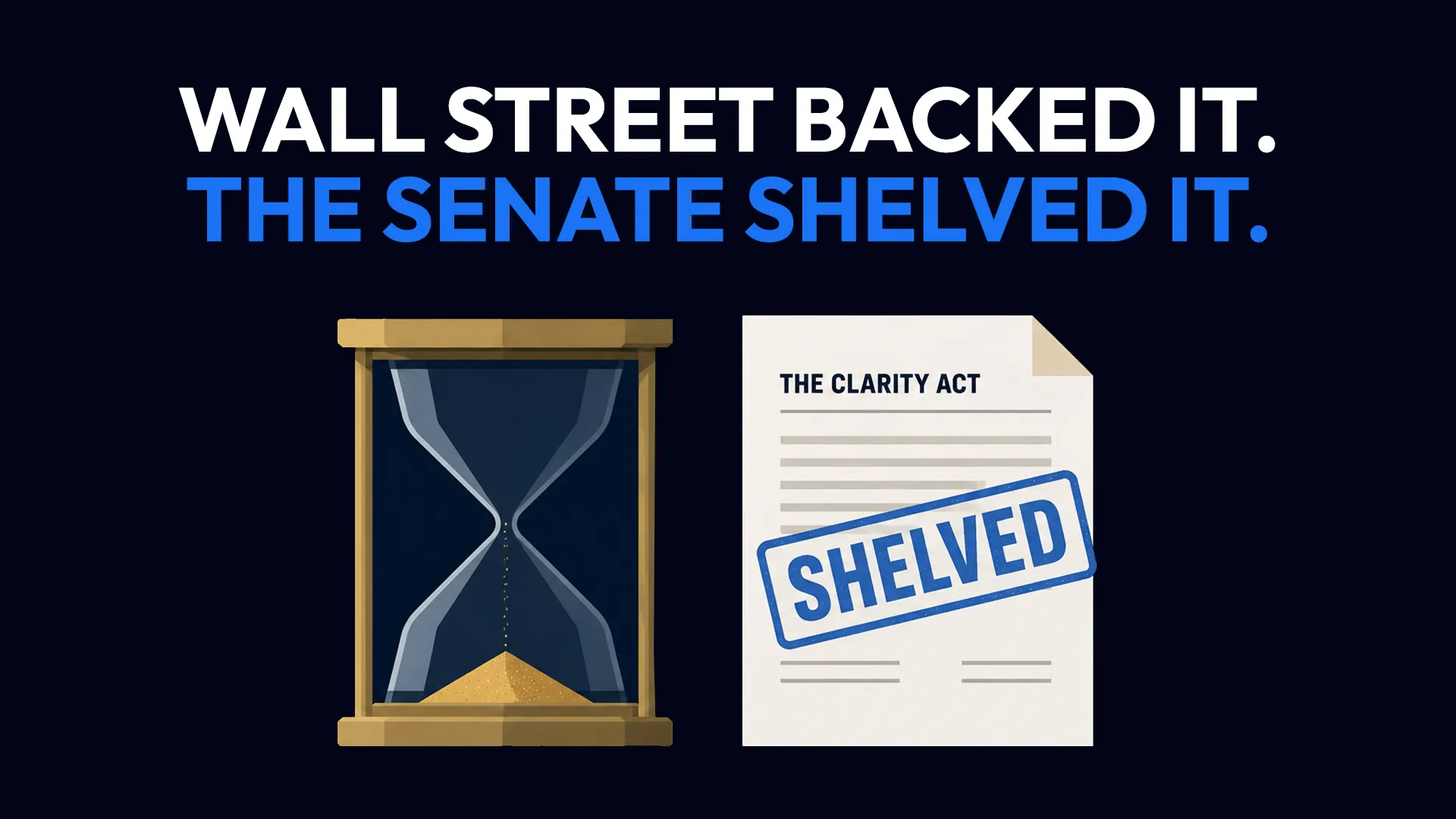
The Digital Asset Market Clarity Act did not make it to the Senate floor this week. Majority Leader John Thune shifted the chamber's attention to a package of 74 federal nominees and the Lindsey O. Graham Sanctioning Russia and Iran Act of 2026, leaving the Clarity Act without floor time as the Senate heads into its August recess. Prediction market odds of passage fell to 34%. The bill still has life, but the path is narrowing in ways that deserve honest accounting.
The institutional support behind the bill has never been stronger. BlackRock, Fidelity, Goldman Sachs, Coinbase, Ripple, and the Digital Chamber all formally backed the legislation this week, with Goldman CEO David Solomon describing it as imperfect but worth advancing. That level of Wall Street alignment behind a crypto bill is historically significant. Representative Mike Haridopolos, who voted for the House version when it passed 294 to 134 with 78 Democratic votes, warned on Fox Business that continued delays risk pushing crypto businesses and investment capital out of the United States. His argument is not rhetorical: Japan, Singapore, the EU, and Australia have all moved to establish regulatory frameworks while Washington has debated.
September is now the next realistic opportunity, and it comes with complications. The Senate would need to pass its version of the bill, reconcile differences with the House version, and clear both chambers before the end of the current Congress. If that does not happen, the entire process restarts in 2027 with a new Congress and no guarantee that the current level of bipartisan support survives the midterm election cycle. The ethics provision remains the central sticking point: Democrats want state attorneys general to have enforcement power, Republicans drew a hard line against it, and the White House has not moved. For Australian users, the stakes are straightforward. US regulatory clarity is one of the primary conditions for the institutional capital flows that drive this market globally. A Clarity Act that fails or gets pushed to 2027 is not a disaster. It is a delay that costs the industry momentum it has spent years building.
The Fed Meets. Bitcoin May Be the Safest Bet in the Room.
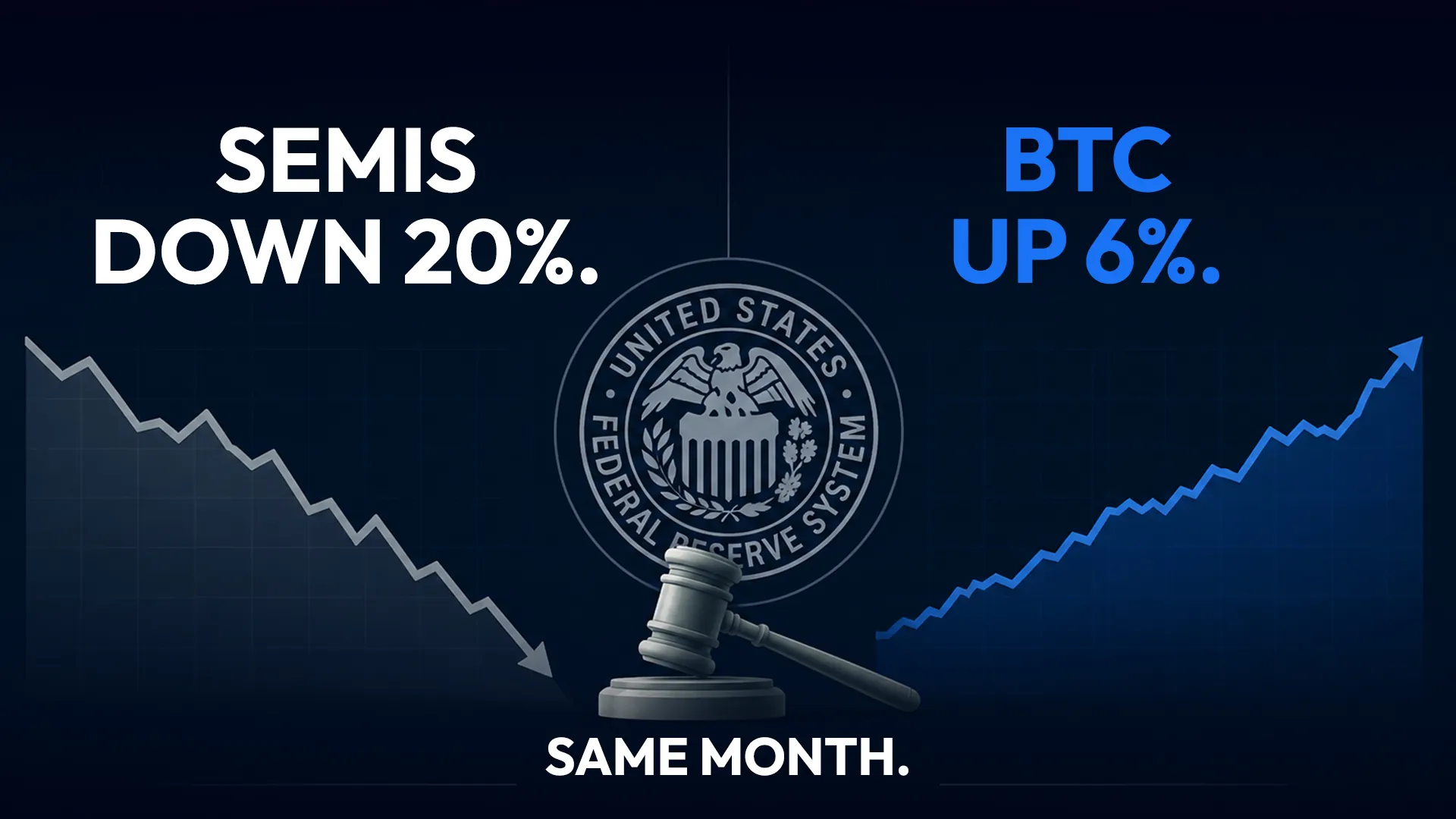
Wednesday's Federal Reserve meeting under Chair Kevin Warsh is shaping up as one of the most genuinely uncertain policy decisions in years. Markets are currently pricing a 70% probability that the Fed holds rates unchanged and a 30% chance of a surprise 25 basis point hike, an unusually wide split that reflects Warsh's deliberate reduction of forward guidance since taking the chair. Block Scholes research analyst Thahbib Rahman noted that looking at every Fed meeting since 2015, only two have seen markets more divided over the outcome than this one. The uncertainty is not manufactured. It is a direct consequence of a central bank that has stopped telling markets what it plans to do before it does it.
The more interesting story is what Bitcoin has been doing while that uncertainty has built. Bitcoin is up approximately 6% for July while the S&P 500 has been essentially flat and a basket of semiconductor stocks has fallen nearly 20%. The correlation between Bitcoin and equities that defined much of the past two years has been weakening at the margin, with crypto sentiment continuing to improve even as AI-linked tech stocks have come under pressure. Vetle Lunde, head of research at K33 Research, wrote this week that with the Nasdaq entering July on stretched positioning while Bitcoin consolidates near multi-year lows, softer correlations are to be expected, and that this week's Fed meeting may have a more limited impact on Bitcoin than in previous periods of policy uncertainty.
The practical read for Australian crypto holders is worth being clear about. A hold from Warsh on Wednesday changes nothing structurally. A hike tightens liquidity and puts pressure on risk assets, though Bitcoin's weakening correlation with equities means the impact may be more muted than it would have been six months ago. The scenario analysts are watching most closely is a hold accompanied by language that signals the Fed is done hiking, what Block Scholes described as anything remotely dovish. That outcome, if it arrives, could be the catalyst that gives Bitcoin's July gains somewhere to go.
Ondo Quietly Reinvented Itself
Ondo Finance announced this week that it has abandoned plans to build Ondo Chain, the conventional layer-1 blockchain it unveiled in February 2025 as the foundation for institutional tokenised asset trading. In its place, the company launched Ondo Network, a private high-speed trading system that separates trade execution from settlement rather than processing everything on a public blockchain. The pivot is significant not just for Ondo but for what it signals about where serious institutional infrastructure is actually heading in the tokenisation space.
The reasoning behind the shift is worth understanding. After building Ondo Perps, its newly launched perpetual futures platform, the team concluded that a traditional public blockchain cannot deliver the speed and privacy that institutional trading requires. Large financial institutions do not want their order flow, positions, and trading activity visible to competitors on a public ledger. Ondo Network addresses this directly: orders are executed privately for maximum speed, while the final transfer of assets settles on public blockchains. The separation gives institutions the benefits of blockchain settlement without the transparency costs that make public chains unsuitable for serious trading activity. Ondo Perps is the first application running on the network, allowing users to trade perpetual futures using tokenised assets as collateral.
The broader context makes the announcement more significant. Ondo has approximately US$2.6 billion (AU$3.72 billion) in tokenised US Treasury products across its OUSG and USDY offerings, and roughly US$850 million (AU$1.22 billion) in tokenised equities, making it one of the largest tokenised asset issuers in the world. Its broker-dealer arm also obtained FINRA approval last week to launch regulated markets and services for tokenised securities. The company Nathan Allman founded and built is now moving from issuing tokenised assets to building the infrastructure for trading them at institutional scale. That is a meaningful evolution, and it is happening faster than most of the industry anticipated. We covered Nathan Allman's passing in a previous edition. The work he started is continuing with momentum.
The US Government Is Nvidia's Silent Backstop
Jim Cramer, host of CNBC's Mad Money, made an argument this week that connects the AI infrastructure race directly to crypto markets in ways worth paying attention to. Cramer's central claim is that Washington will not allow Nvidia to lose the AI competition with China, and that this implicit government commitment functions as a quiet backstop behind Nvidia's most ambitious bets. The evidence he points to is specific: Nvidia is in talks to guarantee approximately US$250 billion (AU$357.5 billion) in financing for OpenAI's lease on a 10-gigawatt data centre campus in Piketon, Ohio, built on decommissioned federal land. Commerce Secretary Howard Lutnick controls power access to the site. OpenAI, Anthropic, Microsoft, and Google have all approached him about it. The full project, including chips, could exceed US$500 billion (AU$715 billion).
The government's involvement goes beyond land access. The electricity powering the campus flows from a natural gas plant funded by a US$33 billion (AU$47.2 billion) Japanese investment, itself part of a recent US trade deal. Lutnick's authority over which company gets access to that power effectively makes Washington a participant in deciding which AI companies win the infrastructure race. Cramer argues that Nvidia benefits from this arrangement in a way that most investors have not fully priced: the geopolitical imperative to beat China in AI makes the US government a structural supporter of the companies at the centre of that race, regardless of what happens to their stock price in any given quarter. Investor Michael Burry has pushed back, arguing that the arrangement is circular, with Nvidia's guarantees funding OpenAI's purchases of Nvidia's own chips, and that OpenAI's lack of investment-grade credit raises questions about the structure's durability.
The reason this matters for Australian crypto holders is the same reason it has mattered all year. Capital that has flowed out of Bitcoin and into AI stocks has not simply left the risk-on trade. It has relocated to a different part of it, one with explicit geopolitical backing and a US$500 billion infrastructure commitment behind it. Understanding why AI has captured the momentum trade that Bitcoin once held is part of understanding what it would take for that momentum to rotate back. Cramer's framing suggests the government backstop is real and durable. If he is right, the competition for speculative capital between AI and crypto is not going away soon. If Burry is right about the circularity, the structure has vulnerabilities that markets have not fully priced.
Morgan Stanley Goes Beyond Bitcoin
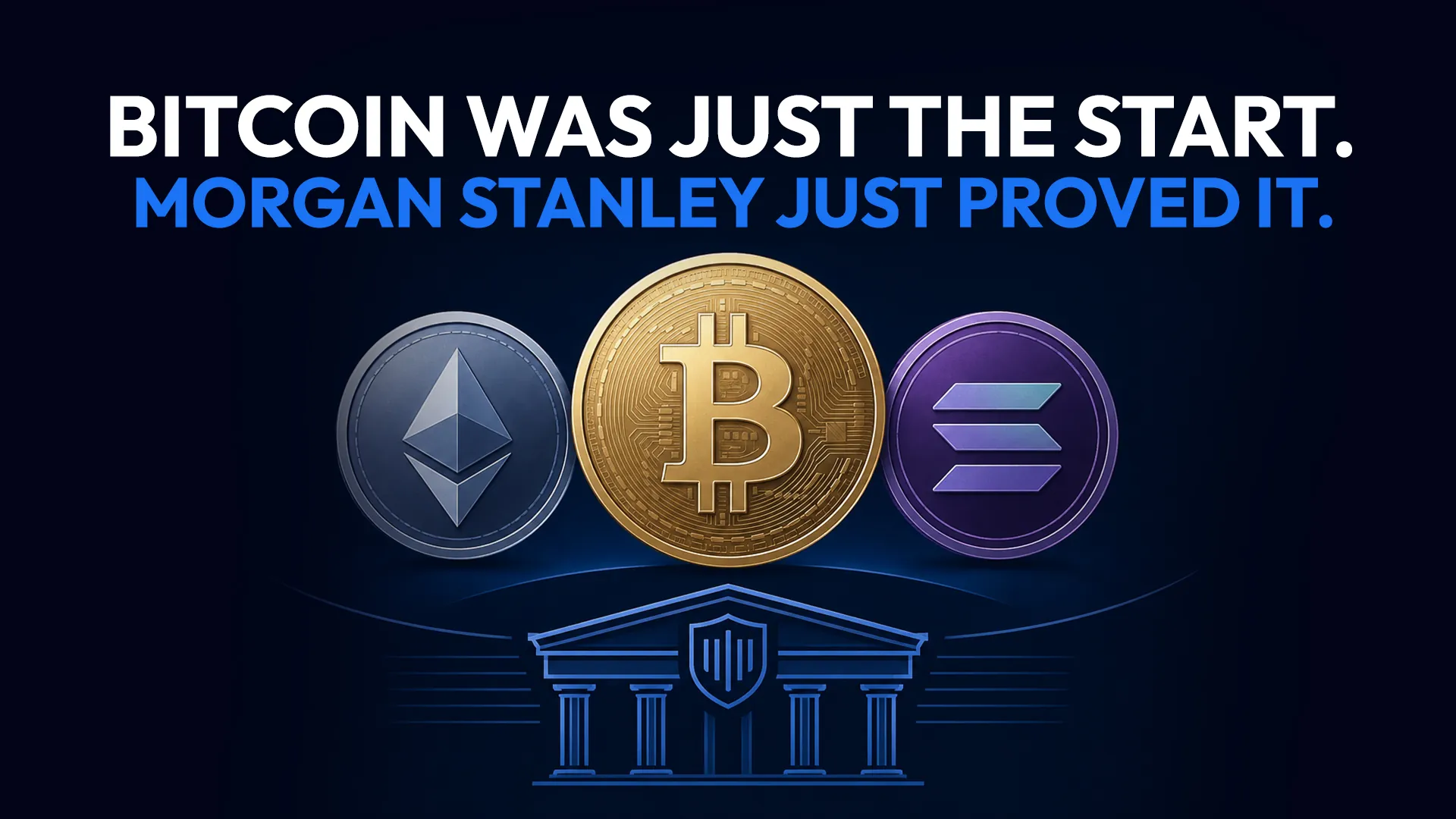
Morgan Stanley Investment Management launched two new exchange-traded products this week, the Morgan Stanley Ethereum Trust and the Morgan Stanley Solana Trust, listed on NYSE Arca under the tickers MSSE and MSOL, respectively. Both carry a 0.14% expense ratio, stake a portion of their holdings, and pass staking rewards directly through to investors. The launches follow Morgan Stanley's spot Bitcoin Trust, introduced in April, which attracted more than US$381 million (AU$545 million) in assets under management through July 16 and helped grow the firm's ETF and ETP platform to more than US$14 billion (AU$20 billion) across 22 products. Amy Oldenburg, Morgan Stanley's head of digital asset strategy, said earlier this year that the firm was not going to stop at Bitcoin. The Ethereum and Solana launches confirm that was not positioning language. It was a roadmap.
The staking component is the detail worth focusing on. By staking a portion of holdings and passing rewards to investors, Morgan Stanley is offering something structurally different from a simple price-tracking product. Investors in MSSE and MSOL are not just getting exposure to ETH and SOL price movements. They are participating in the yield-generating mechanics of proof-of-stake networks, inside a familiar regulated wrapper with Morgan Stanley's name on the front. That combination, institutional trust plus on-chain yield, is precisely what the industry has been arguing would eventually arrive for years. The fact that it has arrived at Morgan Stanley, which manages trillions in client assets and serves one of the most conservative institutional client bases on Wall Street, is a signal about where the mainstream adoption curve actually is.
Morgan Stanley also rolled out spot Bitcoin, Ethereum, and Solana trading for eligible E*TRADE customers this month through a partnership with Zero Hash, allowing clients to buy, sell, and hold digital assets alongside their existing stock and fund portfolios. The firm's digital asset strategy is now coherent, multi-asset, and accelerating. For Australian investors watching the institutional adoption curve, Morgan Stanley's moves this week represent the continuation of a pattern that has been building since the Bitcoin ETF approvals of early 2024: the largest financial institutions in the world are no longer deciding whether to offer crypto products. They are deciding which ones to build next.
When the Day Traders Left, the Exchanges Started Closing
BitMEX, the platform that invented the perpetual swap in 2016 and helped define an era of crypto derivatives trading, announced it will permanently shut down in September. BitMart, another long-running exchange, told its users they have 30 days to close trades and six months to withdraw their funds, without specifying why it was closing. Movement Labs and Storj Labs filed for Chapter 11 bankruptcy in the same week. Four crypto platform failures in seven days is not a coincidence. It is a pattern, and the pattern has a clear cause.
Spot trading volume across major centralised exchanges fell to US$1.05 trillion (AU$1.50 trillion) in April 2026, the lowest monthly total in 25 months. In South Korea, trading volume at the top five crypto exchanges dropped 88% from peak levels. The retail speculation that sustained platforms like BitMEX through years of regulatory trouble, legal battles, and reputational damage has not come back, and analysts who have watched this market closely are not expecting it to return at the scale that sustained those platforms. Jason Fernandes, co-founder of AdLunam, put it plainly: there is not enough volume or retail trading anymore, and the only exchanges that will survive are those not dependent on retail trading to be successful. Michael Van De Poppe, founder of MN Capital, was equally direct: the retail speculation and gambling period is likely behind us.
The BitMEX closure is worth understanding in full context. The platform was fined US$100 million (AU$143 million) for violating bank secrecy rules, its founders were pardoned by Trump in 2025 after criminal convictions, and it is now facing a proposed class action alleging it withheld trader collateral and engaged in insider trading involving 622 BTC worth approximately US$40.5 million (AU$57.9 million). Years of litigation drained the platform of users and credibility long before the formal closure announcement. What this week confirmed is that the compliance reckoning and the volume drought arrived simultaneously, and smaller platforms caught between both have no path forward. OKX Europe's CEO estimated that only 80% of the more than 3,000 virtual asset service providers in the EU will survive MiCA. The exchanges that built compliance infrastructure before they were forced to are absorbing the volume that the others are losing. Platforms that waited are closing. The industry is consolidating around the serious players, and that is not entirely a bad thing.
Founder's Corner
It is interesting to me that the Clarity Act has more institutional support behind it than at any point in its history. BlackRock, Fidelity, Goldman Sachs, and most of serious Wall Street lined up behind it this week. The Senate shelved it anyway. That gap between where the industry has arrived and where the legislation has arrived is worth sitting with honestly. The bill is not dead. September is a real window. What is true is that the industry has done its part, built compliant platforms, attracted institutional capital, engaged with regulators, and the bottleneck right now is political rather than structural. That is frustrating. It is also, in a strange way, a sign of maturity. The industry has outgrown the argument that it cannot be regulated. The remaining argument is about who regulates it and on what terms.
A big story for me was BitMEX; it is a story I wanted to comment on; they invented the perpetual swap and shaped a generation of crypto trading. Its closure this week is a reminder that reputation and innovation are not enough if the compliance foundation was never built. At Wayex, that foundation came first; we have a core focus on ensuring we are always compliant with what's going on and the products we are providing to all customers.
Richard Voice, Co-Founder, Wayex