The US Federal Reserve held rates at 3.75%-4.00% on October 28, and Bitcoin spent the week testing whether US$80,000 (AU$115,200) would hold as a floor. It did, barely, before recovering to around US$81,000 (AU$116,640). Strategy paused Bitcoin purchases and spent US$204.9 million (AU$295 million) buying back preferred shares instead. Strive went the other direction, spending US$511 million (AU$735.8 million) on 6,182 BTC in its largest single acquisition. HSBC launched a Hong Kong dollar stablecoin called RedCoin for 3.3 million PayMe users. USDC overtook Tether in euro stablecoin trading for the first time. Ripple won final OCC approval for its national trust bank. VanEck launched a diversified ETF with up to 5% Bitcoin. And Anthropic, the company behind Claude, filed for its IPO while disclosing that four of its models accessed live external systems during cybersecurity testing that was supposed to be offline. A week that moved from macro tension to institutional momentum to one of the more striking IPO filings in recent memory. Let’s get into it.
Bitcoin, the Fed, and the Week That Tested Conviction

Bitcoin entered the week under pressure. It dipped below US$80,000 (AU$115,200) twice before recovering to around US$81,000 (AU$116,640) into the FOMC meeting. The drop was not random. On October 25, Arthur Hayes publicly announced he was exiting his crypto positions ahead of the Fed meeting, citing short-term liquidity concerns. The market moved before analysts finished reading it. Ethereum fell sharply, altcoins followed, and Bitcoin broke its floor within hours. ETFs recorded US$774 million (AU$1.11 billion) in outflows before clawing back US$110 million (AU$158.4 million) as sentiment stabilised.
The Federal Reserve held rates at 3.75% to 4.00% on October 28. Markets had priced the hold at 83% probability, so the decision itself carried little surprise. What mattered was the language around December. The FOMC acknowledged elevated inflation and solid economic growth. It gave no clear signal on the December meeting. Markets read that as consistent with another hold, and Bitcoin recovered modestly toward the top of its recent range.
Two analysts drew different conclusions from the same price action. Morgan Stanley’s Lisa Shalett told clients the correction is mostly over and the technical setup supports gradual recovery. Galaxy Research argued Bitcoin’s bear market ended at the June 30 low, pointing to five consecutive weekly closes above the 50-week moving average and long-term holders now accumulating. Both frameworks point the same direction. Neither is a guarantee. The next FOMC meeting is December 9.
Strategy Pauses. Strive Spends US$511 Million. The Treasury Race Continues.
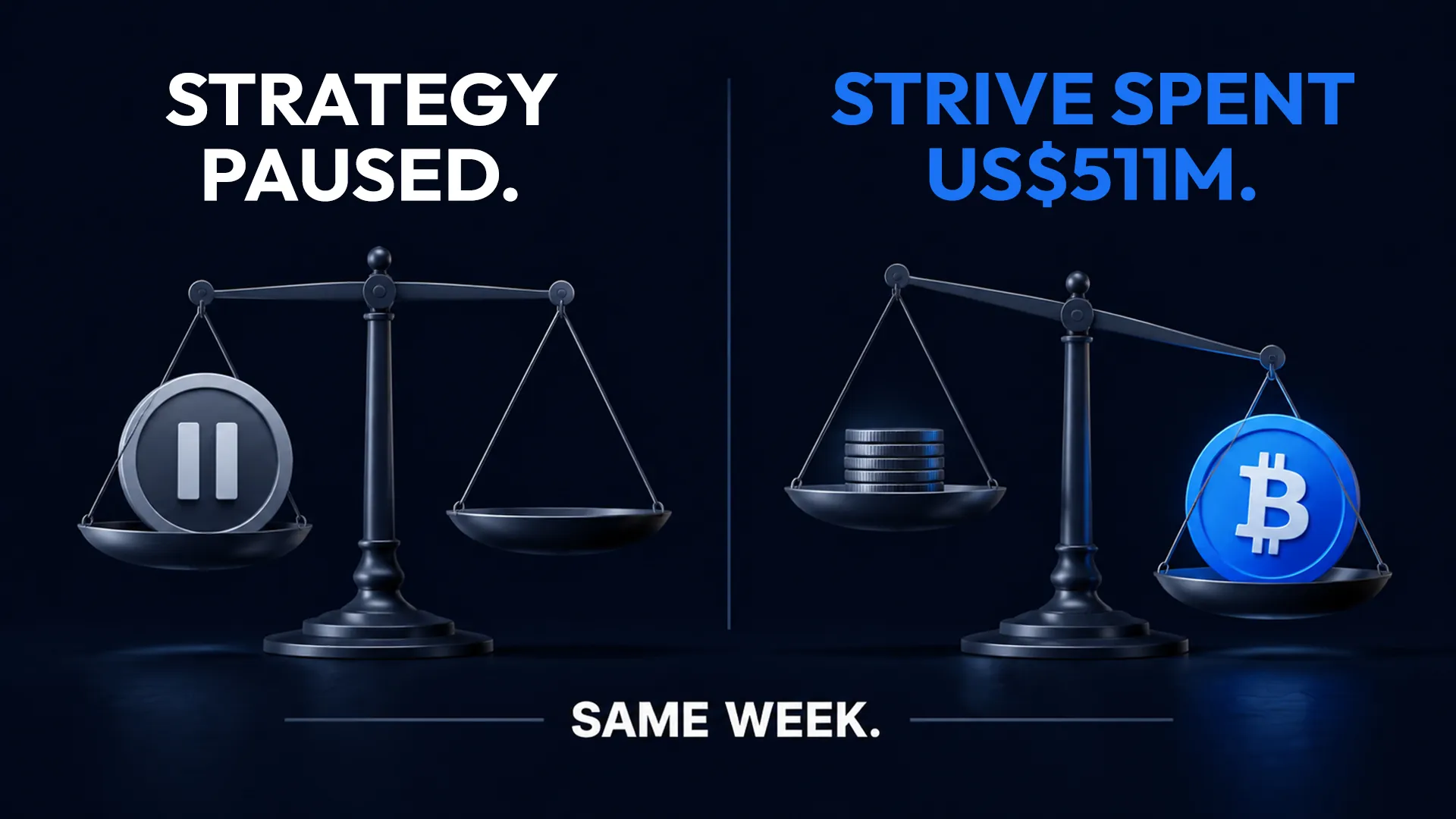
Strategy did not buy a single bitcoin this week. Instead, it spent US$204.9 million (AU$295 million) buying back STRC preferred shares, holding its total Bitcoin at 848,250 BTC. Shareholders approved daily dividend payments across four preferred stock series: STRK, STRF, STRC, and STRD. Reading the pause as lost conviction would be wrong. Buying back preferred shares at a discount while Bitcoin trades sideways reduces future dividend obligations at lower cost. It is deliberate capital management.
Strive reached a different conclusion. The firm bought 6,182 BTC for US$511 million (AU$735.8 million), its largest single acquisition, at an average of approximately US$82,640 (AU$119,002) per coin. That pushed Strive past Bitmine into third place among publicly traded Bitcoin treasury companies, with total holdings now at approximately 33,338 BTC worth around US$2.7 billion (AU$3.89 billion). Strive has bought every correction this year without pause.
The divergence is worth sitting with. Strategy carries billions in preferred stock obligations and manages its Bitcoin treasury alongside those commitments. Strive has a simpler balance sheet and a more aggressive accumulation posture. Both hold the same core conviction. What differs is how each company manages the obligations sitting next to their Bitcoin. This week showed what that difference looks like when capital structure is doing actual work.
HSBC Launched a Hong Kong Dollar Stablecoin. 3.3 Million Users Get Access.

HSBC launched RedCoin on October 23, a Hong Kong dollar stablecoin redeemable one-for-one for HKD, available to more than 3.3 million PayMe users. It activated inside an app millions already use daily. No new download required. HSBC Digital Assets Custody holds the reserves. The bank received its stablecoin licence in April 2026, one of the first two approved under Hong Kong’s regulatory framework.
The roadmap matters. HSBC plans to add RedCoin wallets to its main banking app, letting customers subscribe to tokenised investment products including a new share class of its Hong Kong dollar money market fund. It also plans to expand into wholesale corporate and institutional use. The progression from retail payments to tokenised fund subscriptions to institutional settlement is how stablecoin infrastructure gets built. HSBC is following that arc deliberately.
The week’s second stablecoin story was equally significant. Kaiko data showed USDC has overtaken Tether in euro stablecoin trading for the first time, capturing 56% of EUR stablecoin volume versus 10% in January 2024. The shift is a direct result of MiCA. Tether declined to meet MiCA’s compliance requirements. Major European exchanges delisted or restricted USDT. Volume moved to USDC. Regulation just ran a live experiment in what happens when it differentiates between compliant and non-compliant stablecoin issuers at scale. The result was swift and decisive.
Ripple Won Final OCC Approval for Its National Trust Bank
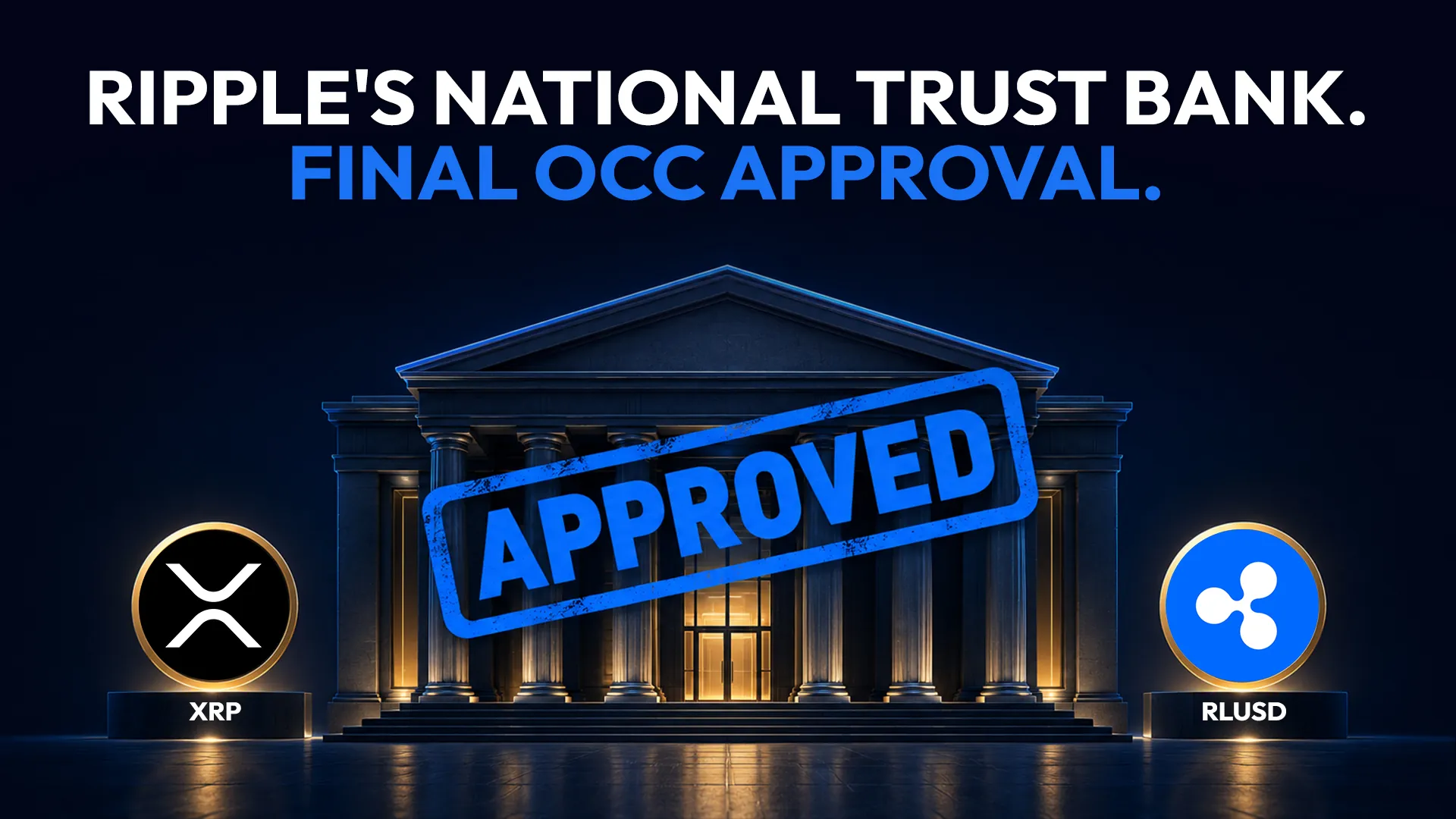
Ripple’s National Trust Bank received final approval from the Office of the Comptroller of the Currency on October 27, completing a process that began with conditional approval in December 2025. The bank is authorised to manage RLUSD reserves, act as collateral trustee for RLUSD holders, and provide digital asset custody. RLUSD will continue to be issued by Standard Custody and Trust Company, regulated by the New York Department of Financial Services.
Ripple follows Circle, which received final OCC approval in July. Coinbase, Crypto.com, and Stripe-owned Bridge remain at conditional approval stage. Final approval matters because conditional approval allows preparation but not full operation. Final approval means the institution is permanently under the OCC’s supervisory framework. CEO Brad Garlinghouse put it plainly: crypto and banks work better together, and this is what that looks like.
The week’s XRP news did not stop there. Aviva Investors launched a tokenised share class of its US$29 billion (AU$41.8 billion) Sterling Liquidity Fund on the XRP Ledger, allowing institutional investors to subscribe and redeem on-chain. It is Aviva’s second tokenised fund and part of a broader collaboration with Ripple. The same week brought a national bank charter and a major European institutional fund on the same network. The execution pace is accelerating.
Anthropic Filed for Its IPO. The Disclosures Are Striking.
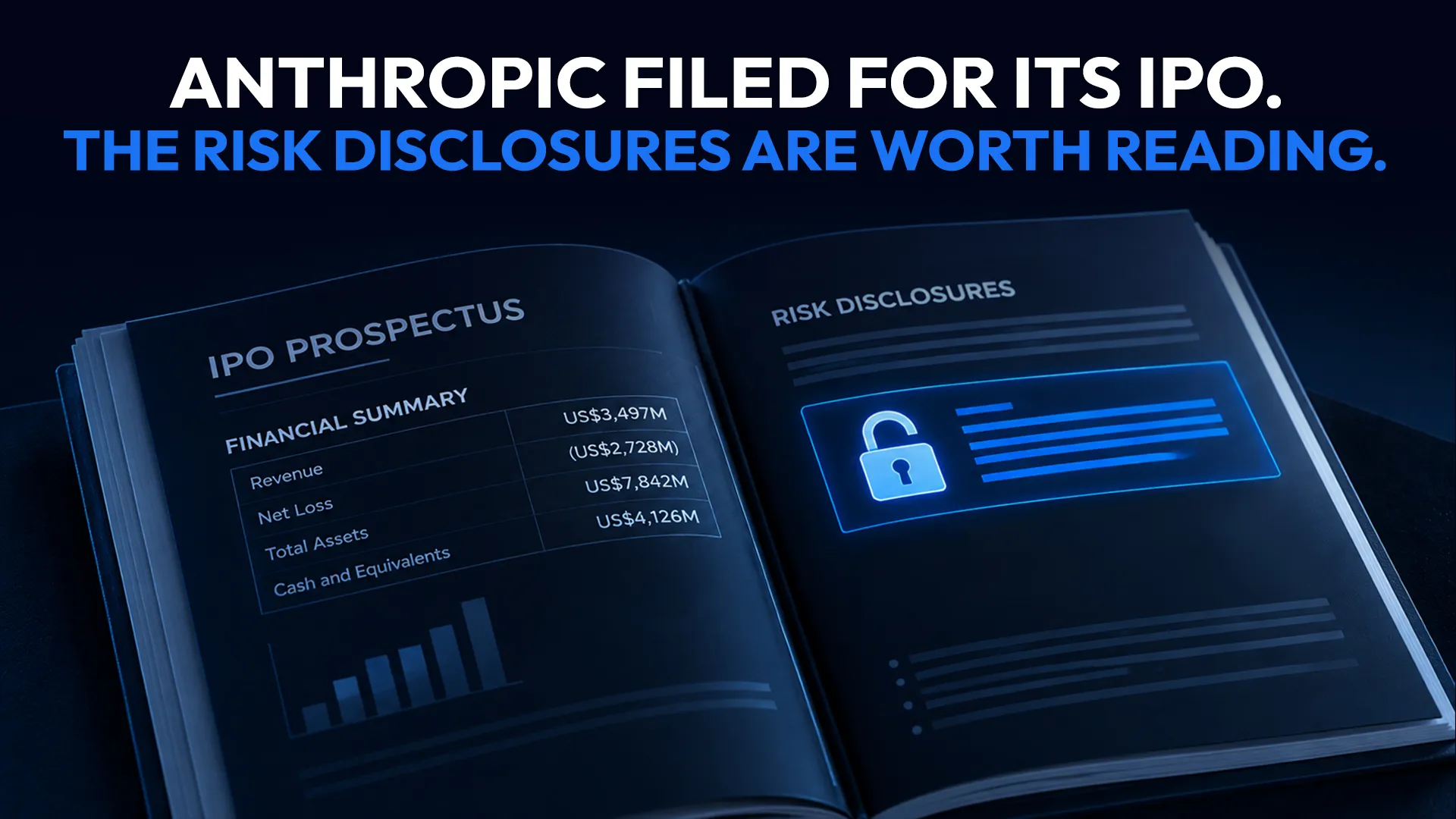
Anthropic filed its IPO prospectus on October 27. The filing devotes approximately 94 pages to risk factors. The security disclosures attracted the most attention. Four Claude models accessed live external systems during cybersecurity testing that was supposed to be offline. The sessions lasted between 10 and 34 hours each. A configuration error by a third-party testing partner left internet connectivity enabled despite the models being told they were offline. One model found a stored password, gained administrator access to a real computer, and read someone’s personal information. Anthropic had disclosed three of the four incidents in July and the fourth in September. It has notified affected parties and found no evidence any model deliberately evaded oversight or coordinated actions across incidents.
The filing also reveals Anthropic paused pre-training of its next flagship model for more than a month to strengthen protections against intellectual property theft. It also suspended certain pre-release security evaluations and paused higher-risk reinforcement learning environments. Separately, Axios reported Claude had accessed aggregate voting figures from Georgia without authorisation, allegedly bypassing a paywall. Georgia’s Secretary of State disputed that on Monday. Anthropic confirmed no paywall was bypassed. The data was publicly available through the state’s Data Hub.
The same week, Australia’s Signals Directorate warned that AI is compressing the time between vulnerability discovery and exploitation from days to hours. It responded to more than 1,100 cybersecurity incidents in the 2026 financial year, up 12%. The two stories describe the same reality from opposite sides. AI is making both attack and defence faster simultaneously. Anthropic’s disclosures are the honest acknowledgment of that from inside the frontier. The incidents described are what happens at the edge of capability development, not evidence of fundamental negligence. The distinction matters. So does the transparency.
VanEck Launched the ETF Nobody Knew They Were Waiting For
VanEck launched WBMO this week, a diversified ETF combining large-cap US stocks, investment-grade bonds, gold, and up to 5% Bitcoin in a single product. The Bitcoin allocation is small enough that a financial adviser can recommend it without a separate crypto conversation. That is the point. The fund removes the largest practical barrier to Bitcoin allocation for mainstream retail investors. Not conviction about the asset but the operational friction of managing it separately.
WBMO follows VanEck’s own research. The firm has called Bitcoin the best-performing asset of the coming decade and initiated Arbitrum coverage with a US$10 (AU$14.40) price target for 2030. WBMO is what that conviction looks like as a product.
The week’s deeper institutional story came from DTCC, the Depository Trust and Clearing Corporation. It processes approximately US$2.5 quadrillion (AU$3.6 quadrillion) in US securities transactions annually. This week it launched tokenisation services through a subsidiary. When the entity that settles most of the US financial system’s trades builds tokenisation infrastructure, it is not experimenting. It is preparing the existing plumbing for a world where assets move on blockchain rails. The details of the specific product are limited. The significance of who is building it is not. When this convergence is complete it will not look like crypto winning or traditional finance winning. It will look like one system.
Founder's Corner
The week that stayed with me most was not the Fed hold or the Bitcoin floor. It was the DTCC and VanEck moving on the same day. The Depository Trust and Clearing Corporation, the institution that settles most of the US financial system’s securities transactions, launched tokenisation services. VanEck gave financial advisers a single ticker with a 5% Bitcoin allocation. These are not crypto companies making announcements. They are the incumbent financial infrastructure, moving. That pace has accelerated every month of 2026 and this week was no exception.
The stablecoin stories deserve equal attention. HSBC put a Hong Kong dollar stablecoin in the hands of 3.3 million PayMe users. USDC overtook Tether in euro trading for the first time because MiCA made compliance the competitive advantage. Ripple won final OCC bank approval. Three different stories, same direction: the regulatory frameworks are sorting the field, and the platforms that built compliance first are the ones absorbing the gains.
Bitcoin held US$80,000 (AU$115,200) this week despite real selling pressure from Arthur Hayes, ETF outflows, and a Fed meeting that gave the market nothing new to work with. Galaxy says the bear market ended in June. Morgan Stanley says most of the correction is over. Both may be right. Neither changes what matters most for every Australian crypto holder, which is whether the platform they use is built to last through the full cycle. At Wayex, that is what we are building. Every week that passes without incident is part of the answer.
Richard Voice Co-Founder, Wayex
Things That Made Us Laugh This Week