Bitcoin fell to US$61,950 (AU$91,700) over the weekend, a four-month low, after slipping below its 200-week moving average of US$68,186 (AU$100,900). The Crypto Fear and Greed Index dropped to 10 out of 100, its lowest reading since June. US spot Bitcoin ETFs lost US$1.9 billion (AU$2.8 billion) over seven trading days before BlackRock’s IBIT broke an 11-session outflow streak with a US$76.5 million (AU$113 million) inflow. Cointelegraph reported that Nvidia’s earnings beat helped steady the market on Wednesday.
Beneath the price, the signals were weak too. Stablecoin supply fell by US$14.2 billion (AU$21.0 billion) in the 30 days to November 9, the biggest drop since June 2022, and short-term holders realised their largest losses since February. A malware campaign dubbed Optimjack put code that swaps crypto wallet addresses on websites run by 178 organisations, including Ledger, Salesforce and the BBC. Strategy bought 485 Bitcoin but spent US$228 million (AU$337 million) on preferred-share buybacks, two Fed governors warned about tokenised finance and AI, and Guardian Australia reported on how federal agencies share data with a fraud centre that uses Palantir software. Let’s get into it.
Bitcoin Hits a Four-Month Low. Fear Reaches 10.
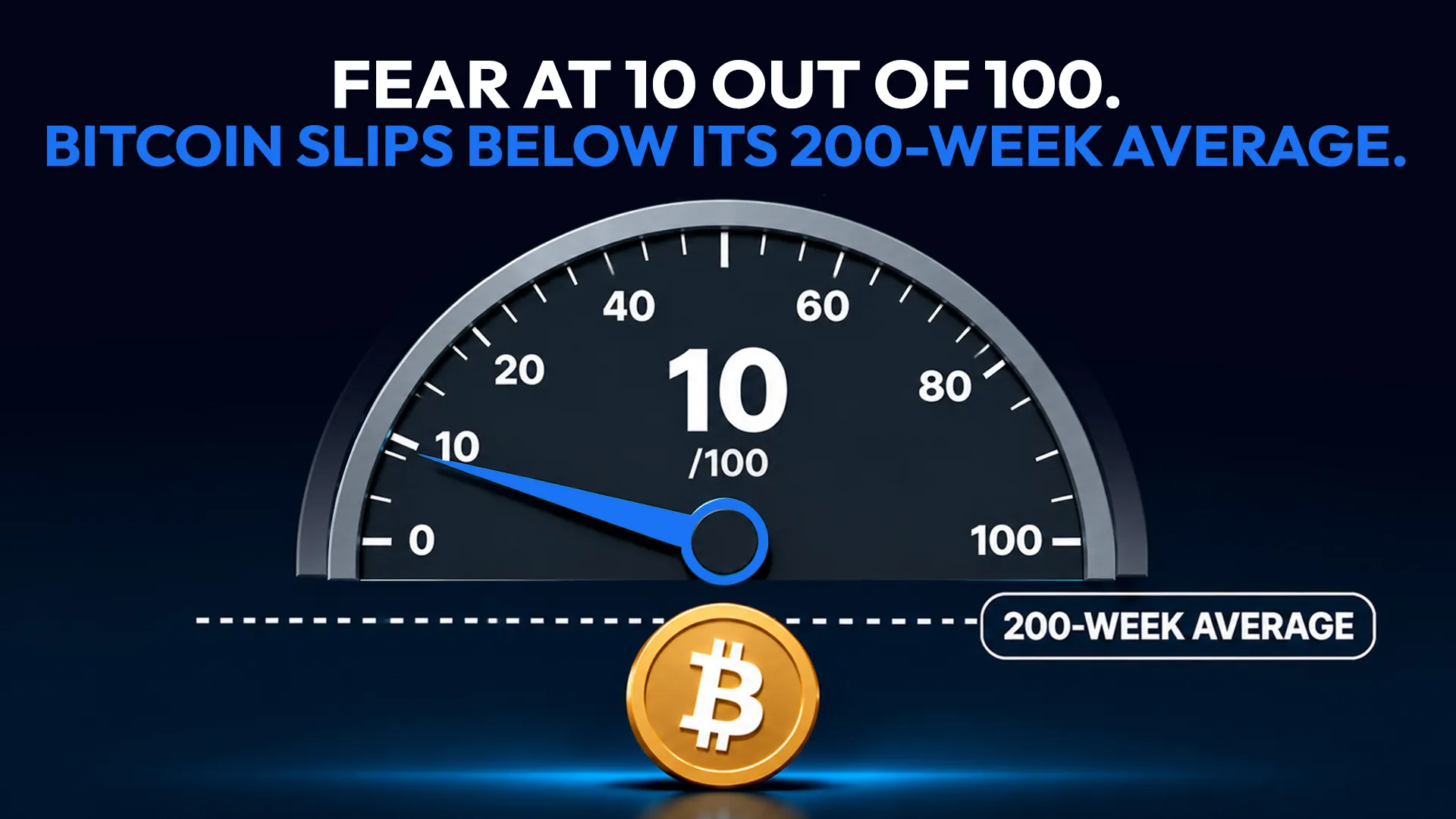
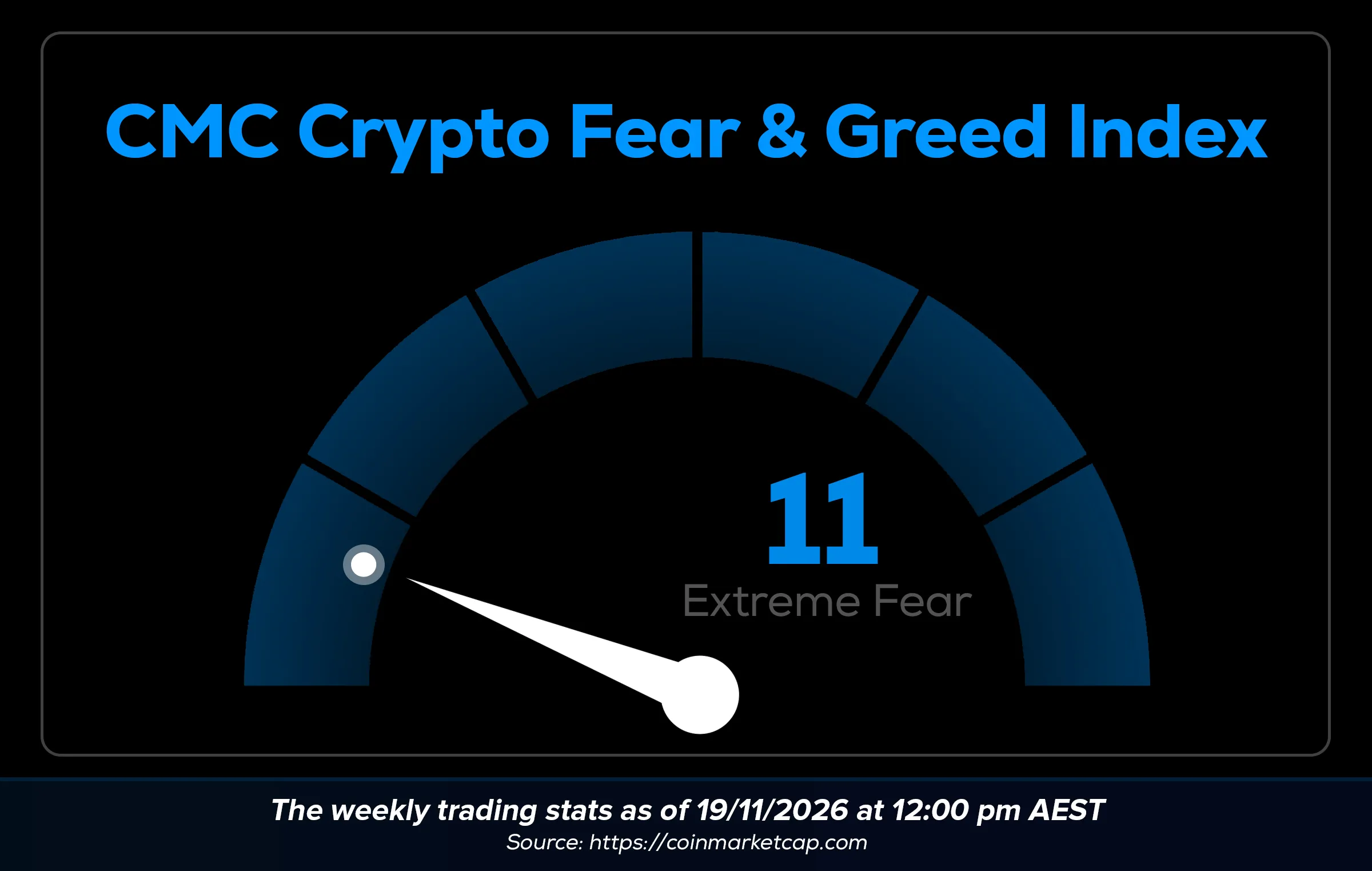
Bitcoin sold off in thin weekend trading and touched US$61,950 (AU$91,700) on Bitstamp, a level last seen on July 13. It recovered to around US$64,500 (AU$95,500) on Monday, but the move pushed it below its 200-week moving average of US$68,186 (AU$100,900). Analyst Rekt Capital noted that dips below this average have historically been part of bear-market bottom formations. Bottoms are only visible in hindsight, so that is context rather than a signal. The Crypto Fear and Greed Index fell to 10 out of 100 on Monday, its lowest reading since June.
Money was leaving the funds too. US spot Bitcoin ETFs recorded seven straight days of net outflows totalling US$1.9 billion (AU$2.8 billion), the longest run since June. That included US$284.1 million (AU$420 million) on Thursday and US$185.4 million (AU$274 million) on Friday.
BlackRock’s IBIT then attracted US$76.5 million (AU$113 million) on Monday, ending 11 sessions of withdrawals that totalled about US$2.35 billion (AU$3.5 billion). Across all US spot Bitcoin ETFs, net flows were a small US$7.9 million (AU$11.7 million). CryptoQuant’s Nick Pitto said that one day of inflows recovered only about 3% of IBIT’s recent withdrawals, and that it’s “too early to call this dip buying”. He added that US Bitcoin ETFs had shed more than 31,000 BTC over the past month. Salman Parcy of Cequire Capital offered a different reading, suggesting some institutions may see the lower prices as an opportunity.
The inflow did not hold. Cointelegraph reported that the funds lost a further US$240 million (AU$355 million), and that CryptoQuant described the market as being in a bearish phase.
The outside backdrop was mixed. Markets have fully priced a quarter-point Fed rate hike for December, and traders were watching Nvidia’s earnings and the Fed’s October minutes. Cointelegraph reported that Bitcoin steadied after Nvidia’s earnings beat, with buyers placing bids near US$60,000 (AU$88,800).
What the Data Under the Price Is Saying

The price is only part of the picture. Several on-chain and market measures also weakened this week, and they show how much of the pressure comes from money leaving rather than from price alone.
The clearest is stablecoin supply. Glassnode data reported by Cointelegraph shows total supply fell by US$14.2 billion (AU$21.0 billion) in the 30 days to November 9. That is the biggest 30-day drop since June 2022, and larger than the US$9.5 billion (AU$14.1 billion) fall recorded when Bitcoin dropped below US$58,000 on July 1. Glassnode says a shrinking supply means holders are redeeming stablecoins for dollars and taking that cash out of the market, leaving “less fuel for a rally”. Tether’s USDT was also trading slightly below its US$1 peg. Glassnode noted that a return to growth in the 30-day figure would be the first sign of new money coming in.
Selling by newer buyers was also heavy. CryptoQuant data shows short-term holders, wallets that have held coins for up to 155 days, were moving Bitcoin at a loss on November 16 at the highest rate since February. Bitfinex Alpha reported that net realised losses across all holders reached about 76,500 BTC on November 15, up from about 18,700 BTC five days earlier. It also noted that 48.5% of Bitcoin’s supply was held at a loss on November 14, the same share as on July 1 when the price was about 11% lower. Bitfinex said stress of this kind has usually been needed for a durable low to form, though the timing is not exact. It added that in June the same measure hit these levels about four weeks before the low arrived.
Leverage was also cleared out. Bitcoin open interest fell about 9.1% to US$20.98 billion (AU$31.0 billion) between Friday and Monday, and fell further to US$20.5 billion (AU$30.3 billion) on Tuesday, its lowest since late 2024. A CryptoQuant contributor wrote that if the flush is complete, a bottoming zone may be near, while continued short positioning could set up a squeeze even in a modest rally. The same analyst identified the US$59,000 to US$60,000 summer low as the next key test.
Read together, the data show a market with less cash on the sidelines and more forced selling at the margins. Whether that marks the end of the sell-off or just a stage in it is something analysts disagree on.
Hackers Hit 178 Websites With Crypto-Stealing Malware

On Monday, visitors to some of the world’s best-known websites may have been served code designed to steal crypto and card details. Security researchers dubbed the campaign “Optimjack”. It spread through scripts hosted by Optimizely, a platform businesses use to run experiments on their websites. Report URI’s investigation found 178 affected organisations, including hardware wallet maker Ledger, OANDA’s Coinpass, IG, Interactive Investor, and TMS Brokers. Cointelegraph also named IKEA, Salesforce, Zoom, the BBC and CNN among the affected brands. The sites themselves were not the target. Their own trusted scripts carried the malicious code.
The code did two things, according to StepSecurity’s analysis. It could swap a legitimate wallet address for one controlled by the attacker when a visitor copied it, so a person pasting an address into a transfer would send funds to the wrong place. It could also capture card details typed into forms hosted on the page. It could not read payment fields isolated inside third-party payment providers’ frames, which limits the card risk on sites that use them.
Optimizely told Cointelegraph that an unauthorised party exploited a vulnerability in its Experimentation account signup flow to add malicious JavaScript to some customer projects. The company says it blocked the vulnerable path, deployed a fix, removed the injected code, ended active sessions, revoked tokens, and notified affected customers. Researchers have not yet established how the attackers got access. Report URI’s Scott Helme said the BBC was among the first sites seen serving the code on Monday, and that by Monday night only one infected snippet still contained malicious code.
Confirmed losses so far look small. Addresses linked to the malware received about US$7,100 (AU$10,500) on Monday according to Cointelegraph’s checks, and StepSecurity put funds across the wallets at about US$6,600 (AU$9,800), noting that some addresses had activity predating the attack. Galaxy Digital’s Alex Thorn estimated victims sent only around US$2,300 (AU$3,400), and said much of the Bitcoin received appeared to be the attacker’s own funds routed through an exchange. Helme said a clipper only pays out when someone copies an address on an infected page and then sends funds, and most of the affected sites were news, software and banking services where that rarely happens. He also said researchers had no evidence that payment cards were actually captured.
Salesforce said it was investigating and had disabled the Optimizely scripts. OANDA, speaking for Coinpass and TMS Brokers, said its internal systems were not breached and it had seen no impact on client funds or account data.
For crypto users, the practical lesson is simple. Before confirming any transfer, check the first and last several characters of the address you are sending to against the one you intended, on the confirmation screen of your wallet or exchange rather than on a webpage. A small test transfer is a sensible extra step for larger amounts.
Fed Governors Warn About Tokenised Finance and AI Risk
Two Federal Reserve governors used speeches this week to raise security and accountability questions about where finance is heading. Their remarks came days after the NYSE chose Avalanche to settle a 24/7 tokenised stock market, which we covered last week.
Governor Christopher Waller spoke at The Clearing House’s annual conference in New York on Tuesday, and cited the US$6.3 billion (AU$9.3 billion) Binance hack while asking who bears responsibility when things go wrong in tokenised markets. His examples included fraudsters exploiting smart contracts, compromised private keys, transfers that fail, and assets stranded on blockchains that stop working. He suggested the right level of security and oversight may depend on how important the transactions are. For systemically important transactions, he said, the most conservative designs may be appropriate, trading some of the developer creativity of open, permissionless networks for more privacy and control. He added that clear legal frameworks for ownership, custody and settlement matter as much as technical safeguards in building trust.
Governor Michael Barr raised a related concern a day earlier, in a speech on AI and cybersecurity as reported by Cointelegraph. He said AI-enabled attackers are exploiting vulnerabilities once considered too hard to target, and that autonomous AI systems could behave in ways that undermine security controls. He noted that attackers only need to succeed once, while defenders have to hold the line every time. Barr also said major banks had reported finding AI agents trying to act in retail customer accounts, without the banks being able to verify whether the agents were authentic or authorised. He pointed to a need for stronger authentication and controls.
The questions are not limited to the Fed. Four Democratic senators wrote to the SEC on Monday asking who would be responsible for tokenised shares that are moved outside regulated platforms, and whether the regulator could freeze or recover them.
None of the three statements opposes tokenisation. They ask who is accountable and what protections should apply, as traditional assets move onto blockchains. Those questions are likely to shape the rules these markets eventually operate under.
Strategy Buys 485 Bitcoin and Spends 7 Times More on STRC
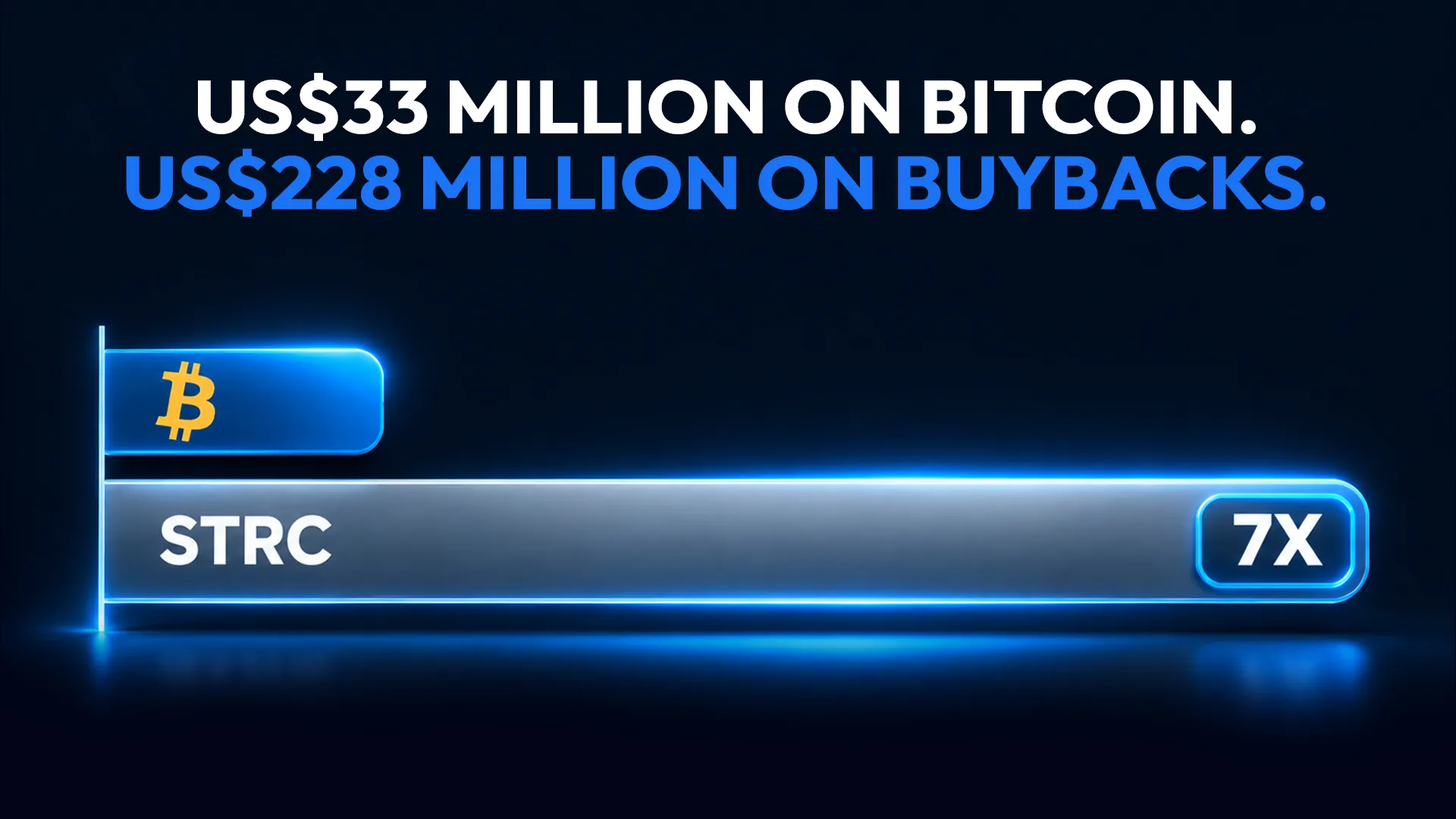
Strategy announced another Bitcoin purchase on Monday, though the filing reported a different figure. The company bought 485 BTC for US$33.4 million (AU$49.4 million) at an average price of US$68,887 (AU$102,000), taking its total to 850,849 BTC. It also repurchased US$228 million (AU$337 million) of STRC, its variable-rate preferred stock, which is about seven times what it spent on Bitcoin.
STRC currently pays a 12% annual dividend. Strategy says it buys shares back when they trade below US$100 (AU$148), aiming to support their price and reduce future dividend obligations. Crypto News Australia reported that most of the buyback was funded by selling ordinary MSTR shares. In other words, the company raised money by issuing common stock and used most of it to retire preferred stock.
The Bitcoin it holds is currently worth less than it paid. Strategy’s average acquisition price is US$75,452 (AU$111,700) per coin. At the time of Crypto News Australia’s reporting, Bitcoin was trading around US$64,891 (AU$96,000), roughly 14% below that average, and the price has since moved.
A further event is on the calendar. MSCI has confirmed it will remove Strategy from its equity indices after the close on November 30. Funds that track those indices may need to sell MSTR shares, which could add pressure at a time when the company relies heavily on share issuance to fund its Bitcoin purchases.
Strategy still holds just over 4% of Bitcoin’s maximum supply of 21 million. Further down the list, the ranking is tight. Metaplanet is second with about 44,000 BTC, Twenty One Capital is third with 43,668 BTC, and Strive is fourth with 43,404 BTC, so the three sit within about 600 coins of each other. Metaplanet also reported a US$170 million (AU$252 million) net loss, partly due to a Bitcoin sale and valuation losses.
Treasury companies built their strategies in a rising market. A falling price shows how differently each one funds itself and what it chooses to do when its own securities trade below target.
Australian Agencies Share Data With a Fraud Centre That Uses Palantir

Freedom-of-information documents reported by Guardian Australia on Monday show that at least 10 federal agencies share sensitive information with a fraud intelligence centre that uses Palantir software. Crypto News Australia summarised the report, which drew on documents obtained by independent researcher Dr Gabrielle Josling. The agencies supply data to the Australian Criminal Intelligence Commission (ACIC), which hosts the Fraud Fusion Centre. The centre serves the Fraud Fusion Taskforce, which Services Australia and the NDIA have jointly led since November 2022 to target welfare, NDIS and childcare fraud.
The Department of Education documents name Services Australia, the NDIA, the ATO, the AFP, ASIC and AUSTRAC among the sources. The Guardian reported that Services Australia authorised the commission to obtain names, dates of birth, addresses and phone numbers, and that the approved categories also cover Centrelink claims, itemised income and assets, bank account details and surveillance material. Services Australia made 47 disclosures to the commission in 2024-25 and 21 in 2025-26. The ATO made 758 disclosures between November 2022 and July 2026, including 42 to the commission.
The Palantir question is where the reporting is most careful. The ACIC has held Palantir software maintenance contracts since November 2018, according to AusTender notices. The commission describes Palantir as one of several analytical tools it applies to specific cases to help partners disrupt organised crime networks. The documents show the shared data could be fed into the software, but they do not show whether any particular dataset was. The Guardian found that neither the ATO nor Centrelink knew whether Palantir had been run over their information, and the commission did not say whether the agencies were told. Palantir says it has no access to the data its clients enter into its software.
The documents also raise oversight questions. A privacy impact assessment noted that the commission is not covered by the Privacy Act. A 2024 agreement required an ethics and human oversight framework for the taskforce, but correspondence from September 2025 found the framework too difficult to implement, and an ethics guide replaced it a month later. The commission says its handling of the data is governed by agreements with each supplying agency. The Australian National Audit Office is assessing whether taskforce members share data effectively, with its report due in March 2027.
There is a link to crypto, though a limited one. A draft law, covered in our October 22 edition, would make the ATO the recipient of crypto platforms’ reports on Australian users’ trades from July 2027. Nothing in the documents says crypto reporting data has been or will be shared with the commission. For readers, the story reminds us that information given to one agency can travel, within the rules that apply, and those rules are still being tested.
Founder’s Corner
It was a hard week for the market. Bitcoin fell to a four-month low, sentiment dropped to its lowest reading since June, and stablecoin supply shrank at the fastest pace in more than four years. If you have been watching your portfolio, I understand why this week felt heavy. Weeks like this are part of how this market works, and the useful response is usually to stay informed and keep your decisions calm and considered.
What stayed with me most was not the price. It was the story about Optimjack, the malware campaign that reached 178 websites through a single trusted script. The sites involved were not obscure. Many were names people use every day, and the attack worked because visitors had no reason to doubt them. The code was built to swap a wallet address at the moment someone copied it. Most of the reported losses were small, which is a relief, but the method is worth remembering.
It connects to what the Fed’s Governor Waller said about tokenised finance this week. His question was who is responsible when keys are compromised or a transfer goes wrong. That question matters just as much for individuals as it does for banks. As more of finance moves onto blockchains, the checks we do ourselves matter more. Before you confirm any transfer, compare the address on your wallet or exchange confirmation screen against the one you meant to send to. For larger amounts, a small test transfer first is a sensible habit. It takes a minute, and it is one of the few protections that does not depend on anyone else.
At Wayex, compliance, security and responsible operations are not things we think about only in weeks like this one. They are part of how we run a regulated Australian exchange, every day.
Thank you for reading, and for trusting us with your time each week.
Richard Voice Co-Founder, Wayex
Things That Made Us Laugh This Week