This week in crypto feels like an industry showing its full range in a single seven-day window. President Trump posted on Truth Social, stressing the importance of maintaining the CFTC's exclusive authority over prediction markets and vowing to protect the cryptocurrency industry, a statement that landed with the familiar mix of optimism and scepticism that follows most of his crypto pronouncements. Base launched a tool that lets AI agents manage crypto wallets, raising a question the industry has not fully answered yet: how much control are you actually willing to hand over? The UK blacklisted HTX over alleged facilitation of Russian sanctions evasion, a reminder that regulatory crackdowns are accelerating and compliance is not a competitive advantage; it is the baseline. The Bankless founder sold his ETH and explained why, Cardano's internal drama heated up, and the industry lost one of its most consequential builders when Nathan Allman, the founder and CEO of Ondo Finance, passed away unexpectedly at 32. We will cover that story last and with the care it deserves. The rest of the week had energy, controversy, and genuine questions worth sitting with. Let's get into it.
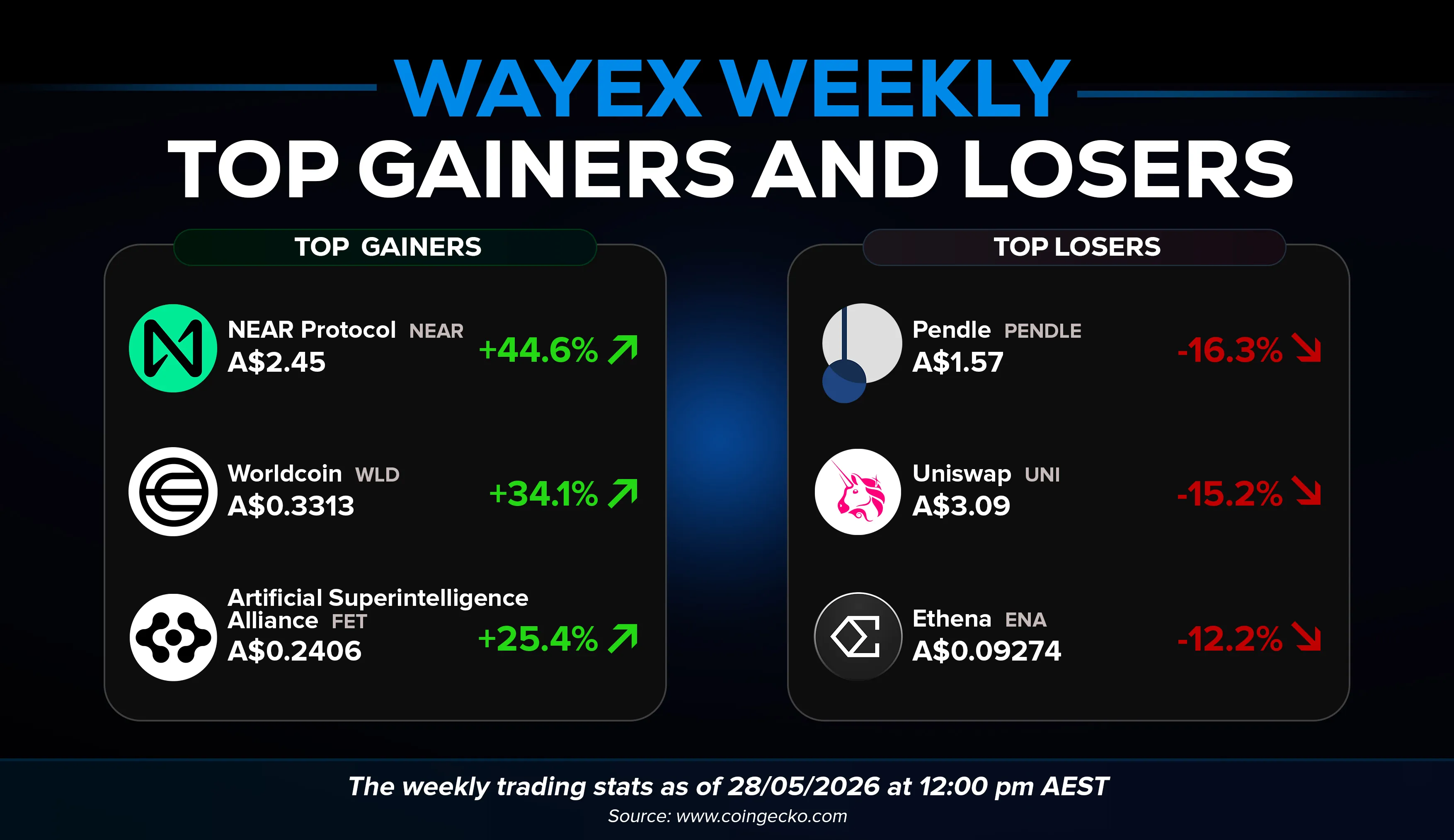
Top Gainers & Losers on Wayex
Trump's Crypto Promises, Hopium or Something Real?
President Trump posted on Truth Social on May 26, stressing the importance of establishing the CFTC's exclusive authority over prediction markets and vowing to protect the cryptocurrency industry, writing that it is critically important that prediction markets will thrive. For anyone who has followed Trump's relationship with crypto, the reaction to a post like this is complicated. The administration has delivered some genuinely meaningful wins for the industry, from Kevin Warsh's confirmation as Fed Chair to the executive order on payment rails we covered last week. The political will appears real. The execution, however, is where things get complicated.
Trump's statement comes amid a live power struggle between state and federal authorities over who should regulate the fast-growing prediction market sector, with states arguing that some event contracts should fall under gambling laws. The dispute covers sports and entertainment-linked contracts, with lawsuits and federal court cases already testing the boundaries of state and federal power. The complication that nobody in the administration seems eager to address directly is the conflict of interest sitting in plain sight. Trump's family ties to Polymarket and Kalshi have added scrutiny as Congress probes the prediction market sector. When the president publicly posts that prediction markets will thrive and his son is an adviser to the two largest platforms in that space, the line between policy and personal interest becomes genuinely difficult to read.
None of that makes the underlying policy wrong. Regulatory clarity for prediction markets is good for the industry, good for innovation, and good for Australian crypto users who interact with these platforms. But the honest read on Trump's crypto promises has always been the same: the direction is broadly right, the motives are genuinely mixed, and the gap between what gets announced on Truth Social and what actually becomes durable law is wide enough to drive a truck through. Watch what gets legislated, not what gets posted.
Base Launches AI Agents for Your Crypto Wallet: Would You Trust It?
Coinbase's Layer 2 network Base launched a tool this week that allows AI agents to connect directly to crypto wallets and manage them autonomously. The pitch is straightforward: instead of manually executing trades, managing positions, or moving assets between protocols, you plug in an AI agent and let it handle the decisions on your behalf. It is the most forward-looking story of the week, and it raises a question worth sitting with honestly rather than either embracing uncritically or dismissing as science fiction.
The technology itself is not speculative. AI agents managing crypto wallets is a logical extension of the broader AI automation wave that is already reshaping how software gets built, how businesses operate, and how decisions get made at scale. Base is one of the most credible infrastructure layers in the ecosystem, backed by Coinbase, with real developer activity and real transaction volume. When Base ships something, it is worth paying attention to. The question is not whether this technology works. The question is whether handing autonomous control of your financial assets to an AI agent is something you are genuinely comfortable with, and what happens when it gets something wrong.
The risks are not hypothetical. AI agents make decisions based on the parameters they are given and the data they can access. They do not have intuition, they do not understand context the way humans do, and they cannot be held accountable in the way a human financial adviser can. A poorly configured agent, a data feed error, or a market condition the model was not trained on could result in significant losses before any human has the chance to intervene. This is not a reason to dismiss the technology. It is a reason to approach it with the same seriousness you would apply to any decision about who or what you trust with your money. At Wayex, we think the future of crypto is one where technology does more of the heavy lifting, but where the human remains in control of the decisions that matter most. The AI agent conversation is just getting started. It is going to be one of the defining debates in this industry over the next few years.
The UK Blacklists HTX
The United Kingdom added HTX, the crypto exchange formerly known as Huobi, to its sanctions list this week over allegations that the platform facilitated the movement of Russian funds to bypass international sanctions. The delisting is significant not just for HTX but for what it signals about where global regulatory enforcement is heading and how quickly the compliance bar is rising for every exchange operating in international markets.
HTX has operated in a grey zone for some time. The exchange rebranded from Huobi in 2023 following Justin Sun's increased involvement, and it has faced persistent questions about its compliance practices, its ownership structure, and its relationship with jurisdictions that sit outside the mainstream of Western financial regulation. The UK's decision to formally blacklist it is not a surprise to anyone who has been paying close attention. What it represents is the continuation of a clear pattern: regulators in major jurisdictions are no longer content to watch crypto exchanges operate at the margins of the compliance framework. They are drawing hard lines and making examples.
The message for the broader industry is straightforward. The era of crypto exchanges operating with minimal regulatory oversight and hoping to quietly serve all markets simultaneously is ending. The exchanges that will matter in five years are the ones that built their compliance infrastructure before they were forced to, not after. For Australian users, this story has direct relevance. The Australian regulatory environment is tightening in parallel with the UK, the EU, and the US. Choosing where you hold and trade your crypto is a decision that carries real risk, and the risk is not just price volatility. It is counterparty risk, jurisdictional risk, and the very real possibility that an exchange you rely on gets cut off from the financial system with little warning. Platforms operating under proper Australian licensing and compliance frameworks exist for exactly this reason. Wayex is one of them.
Why Did The Bankless Founder Sell His ETH?
Ryan Sean Adams, co-founder of Bankless and one of Ethereum's most prominent advocates, sold his ETH this week and published a detailed explanation of why. His co-founder David Hoffman wrote the accompanying piece that unpacks the reasoning, and it is one of the more honest and intellectually rigorous things written about Ethereum in a long time. It deserves more than a headline summary.
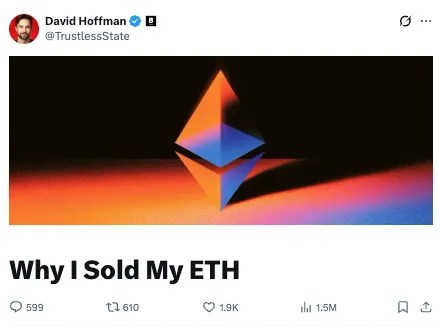
The core argument is not bearish on the Ethereum network. Hoffman is explicit about that. He expects Ethereum to continue doing exceptionally well as infrastructure. His argument is specifically about ETH the asset, and the thesis he has spent years championing: that ETH would become global money. His conclusion is that the thesis did not fail; it just did not succeed to its fullest potential, and the window for it to be repriced higher or lower has largely closed.
The reasoning is layered. Ethereum chose the hardest, most ambitious path, building a Turing-complete blockchain designed to maximise utility for its entire ecosystem rather than its native asset. That architecture is intentionally generous. Ethereum supplies blockspace, secures DeFi, and tokenises real-world assets essentially at cost, passing the value to its applications and Layer 2 networks rather than capturing it in ETH itself. Hoffman describes Ethereum as the world's most successful non-profit. That framing is both a compliment and an explanation for why ETH has underperformed relative to what many expected.
The conclusion is not that ETH is a bad investment. It is that the structural repricing many expected has played out, and capital might be better deployed elsewhere. For Australian crypto holders carrying significant ETH exposure, the honest question Hoffman's piece raises is the same one he asked himself: are you holding ETH because you believe in the network, or because you believe the asset is going to be structurally repriced? Those are two different bets, and being clear about which one you are making matters more than most people acknowledge.
Cardano Is Fighting Itself
Cardano's internal drama escalated significantly this week, with infighting between founder Charles Hoskinson and various factions within the ecosystem heating up in ways that are becoming difficult to ignore. The specifics of the dispute involve governance, treasury allocation, and the direction of the network's development, but the broader story is one that goes well beyond Cardano and speaks to one of the most persistent structural challenges in crypto: what happens when a decentralised network and its charismatic founder pull in different directions.
Hoskinson has always been a polarising figure. He is one of the most technically credible voices in the industry, an Ethereum co-founder who built Cardano with a research-first philosophy that has produced genuinely rigorous academic work. He is also someone who struggles with criticism, engages publicly in ways that sometimes create more problems than they solve, and whose personal brand has become so intertwined with Cardano's identity that separating the two is genuinely difficult. That entanglement is at the heart of this week's drama. When the founder of a network that is supposed to be decentralised is also its most visible spokesperson, its most vocal defender, and its most controversial figure simultaneously, governance questions become personality questions very quickly.
The practical implications for ADA holders are real. Governance disputes of this kind create uncertainty, slow development, and distract from the technical and ecosystem work that actually drives value over time. Cardano has a genuinely committed community, a serious technical roadmap, and real institutional relationships. None of that disappears because of internal friction. What internal friction does is raise the cost of execution and remind participants that decentralised governance is genuinely hard, even when the people involved are smart and well-intentioned. The outcome of this dispute matters. Cardano is too significant a network for this to be a footnote. Watch how it resolves.
Remembering Nathan Allman
We want to handle this one differently from the rest of the Weekly Wrap, because it deserves to be.
Nathan Allman, the founder and CEO of Ondo Finance, passed away unexpectedly at the age of 32. The company announced his passing on Monday without disclosing the cause of death. Ian De Bode, Ondo's longtime president, has stepped in as CEO.
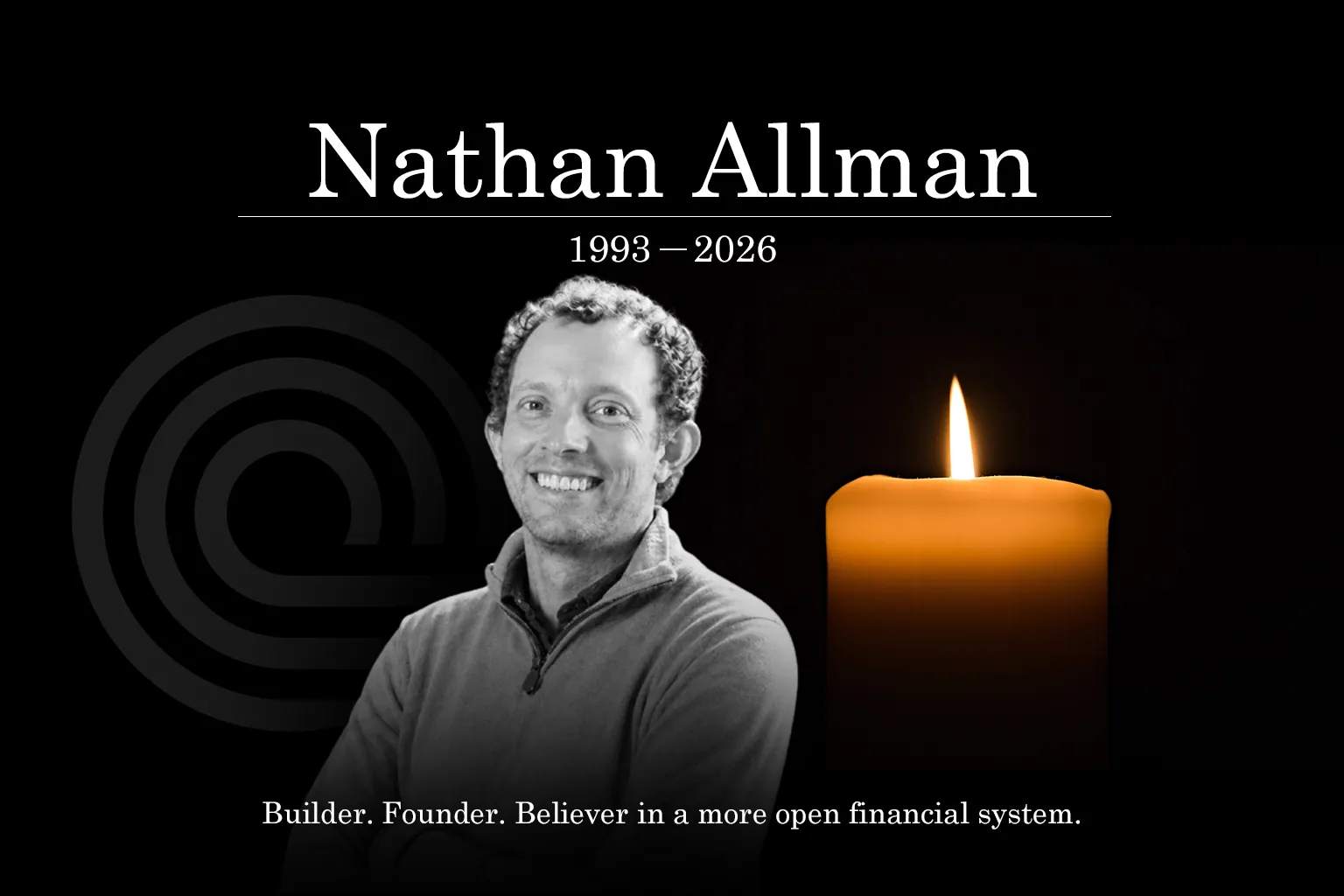
Allman occupied the narrow intersection of Wall Street rigour and Web3 idealism that most people only talk about. He actually built there. His path to founding Ondo was not a typical crypto origin story. He studied economics and biology at Brown University, earned his MBA from Stanford, worked at Prospect Capital Management, co-founded ChainStreet Capital, a quantitative crypto hedge fund, and then joined Goldman Sachs, where he worked on the bank's digital assets team. He was not someone who stumbled into crypto. He understood institutional finance from the inside and made a deliberate choice to build something that could bridge it with the decentralised world.
What he built was Ondo Finance, which he founded in 2021 and grew into a tokenised real-world asset pioneer with $3.5 billion in total value locked, products including the USDY yield-bearing stablecoin and the OUSG tokenised US Treasury fund. In a space that talks endlessly about bringing traditional finance on-chain, Allman was one of the few people actually doing it at an institutional scale, with the credibility and the track record to make major financial institutions take it seriously.
Industry leaders, including Stani Kulechov, founder of Aave, and Robert Leshner paid public tribute to Allman's contribution to the sector's maturation. Their responses reflected something specific: Allman occupied the narrow intersection of Wall Street rigour and Web3 idealism that most people only talk about.
The industry lost someone genuinely irreplaceable this week. Our thoughts are with his family, his team, and everyone who knew him. The most meaningful thing the industry can do to honour his memory is to keep building the version of crypto he believed in: open, accessible, and built to last.
Founder's Corner
This week had a different feeling to it. Not because the headlines were particularly dramatic, though some of them were, but because of the range. Trump is posting crypto promises on Truth Social. AI agents are being handed the keys to wallets. A major exchange is getting blacklisted. One of the industry's most prominent voices is explaining publicly why he sold his most cherished asset. Cardano is fighting with itself. And an industry mourning someone who was 32 years old and had already built something most people spend a lifetime trying to build.
The Nathan Allman story is the one I keep coming back to. Not because of what it means for Ondo Finance, which has strong leadership and will continue the work he started, but because of what it reminds you about this industry and the people in it. Crypto can feel abstract. It is prices, protocols, governance debates, regulatory battles, and market cycles. But underneath all of it are people who made genuine sacrifices to build something they believed in. Nathan Allman was one of those people. He left Goldman Sachs to build a bridge between institutional finance and the decentralised world at a time when most people thought that was either impossible or irrelevant. He was right that it mattered. The numbers prove it.
The David Hoffman piece on ETH is the other story I want to sit with. Not because I agree or disagree with his conclusion, but because of what it models. He built a career, a community, and an identity around a thesis, and when the evidence told him the thesis had played out, he said so publicly and acted accordingly. That kind of intellectual honesty is rare anywhere, and it is particularly rare in an industry where conviction and tribalism are often indistinguishable from each other. Whatever you hold, whatever you believe about where the market is going, that willingness to revisit your assumptions and be honest about what the evidence is telling you is a habit worth building. .
Richard Voice, Co-Founder, Wayex