The Clarity Act needs 60 Senate votes to pass, and it is losing Democrats faster than it is finding them. Bitcoin is sitting around US$62,000 (AU$88,660) while the Coinbase CEO polls his followers on whether the bottom is in and the US government quietly moves US$288 million (AU$412 million) in seized crypto to an exchange. Ethereum published its most ambitious technical roadmap in years. SpaceX has given back almost all of its IPO gains. Stripe made a US$53 billion (AU$75.8 billion) offer to buy PayPal, which is really a story about stablecoins hiding inside an M&A headline. A week where the political, the technical, and the financial all pulled in different directions at once. Let's get into it.
The Clarity Act Is Losing Democrats
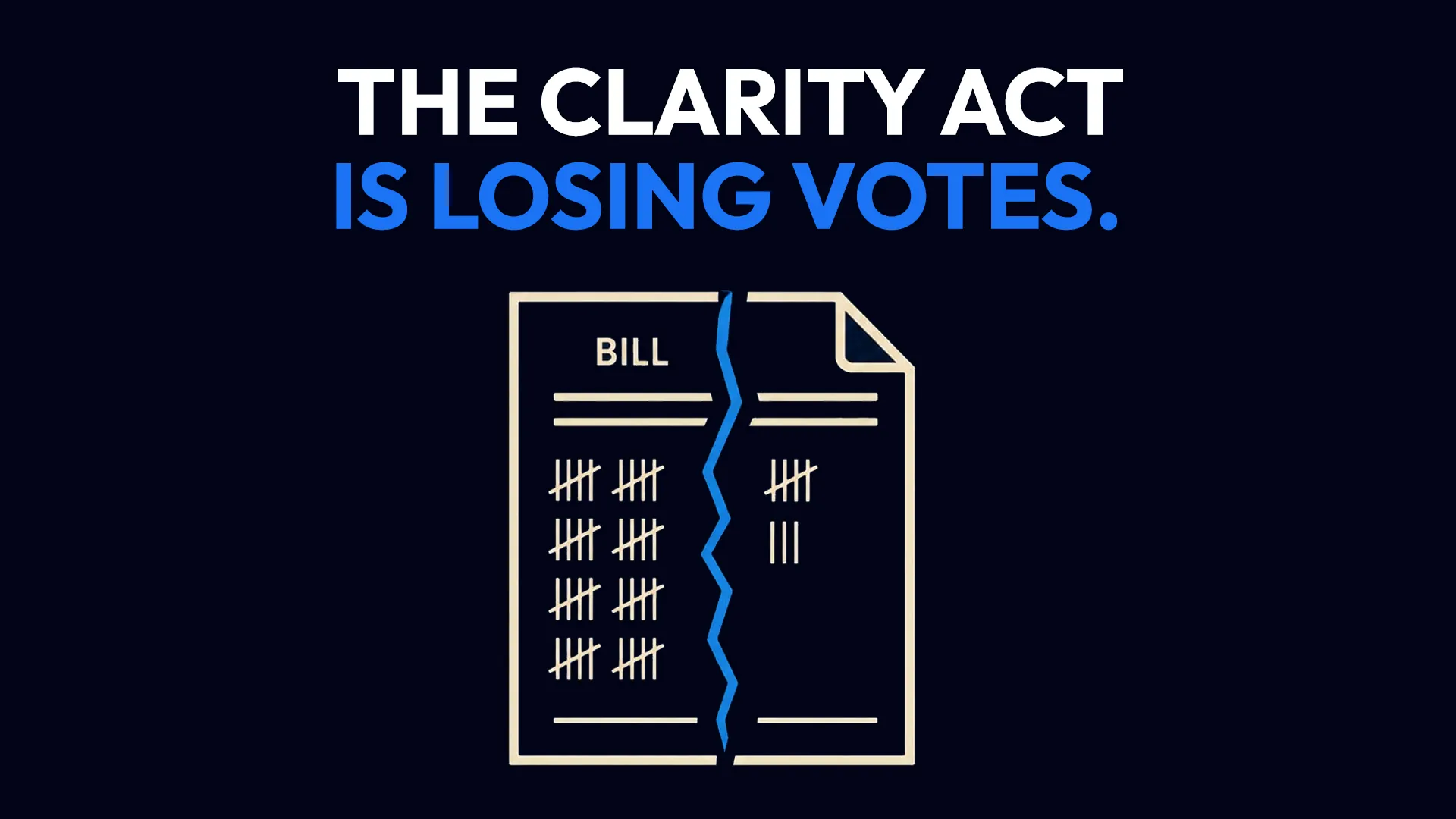
The most important piece of crypto legislation in a generation is running out of time and running out of votes. Three Senate Democrats, Chris Murphy, Chris Van Hollen, and Jeff Merkley, held a press conference on Capitol Hill this week to formally declare their opposition to the Digital Asset Market Clarity Act, calling it a corrupt piece of legislation that will do a lot of harm. The bill needs 60 votes to clear the Senate, which means it requires a meaningful number of Democrat crossovers. Those crossovers are not materialising, and the reason is sitting in plain sight: Trump's financial disclosure showing more than US$1.4 billion (AU$2 billion) in personal crypto income last year has given opposition Democrats an argument that is difficult to counter without directly addressing the conflict of interest it represents.
The sticking point is a provision that would ban senior government officials from personally participating in the crypto industry. Democrats who have been at the negotiating table and voted yes when the bill cleared the Senate Banking Committee have said publicly they cannot support a final version that does not include it. The White House has shown no appetite for a provision that would require Trump and his family to divest from ventures that generated the better part of a billion dollars last year. Senator Murphy was characteristically direct: if this bill does not stop Trump's corruption of the entire industry, it is worthless. Senator Van Hollen went further, calling the bill itself a fundamental corruption if it gives Trump's financial entanglements the protection of law.
The window for the Clarity Act to pass before Congress breaks for summer and pivots to midterm election focus is narrow and getting narrower. A new and potentially final draft was expected to emerge this week, but it remained absent a resolution on the ethics provision that is the last and most important sticking point. The bill is not dead. Legislation has survived worse moments than this one. What is clear is that the industry's assumption that bipartisan momentum would carry Clarity to passage is being tested by a conflict of interest that nobody in the Trump administration seems willing to resolve. For Australian users, the consequences of a failed Clarity Act are real: US regulatory clarity drives global institutional capital flows, and those flows are part of what determines when and how this market recovers. Watch the next two weeks very carefully.
Has Bitcoin Bottomed? Coinbase's CEO Asked. Most Said No.
Coinbase CEO Brian Armstrong posted an informal poll on X this week asking his followers a simple question: is the bottom in? Of the more than 20,000 people who responded, 55.8% said no. Armstrong later clarified he was asking specifically about Bitcoin, not the broader crypto market, and added that several other parts of the ecosystem, perpetual futures trading, stablecoin payments, prediction markets, and tokenised real-world assets, have continued growing through Bitcoin's prolonged downturn. The poll is not a scientific instrument. What it captures is sentiment, and sentiment right now is cautious at best.
Bitcoin is trading around US$62,000 (AU$88,660), down from its all-time high above US$126,000 reached last year and sitting below both its seven-day moving average of around US$63,239 (AU$90,432) and its 200-day moving average near US$73,740 (AU$105,448). The Iran conflict re-escalation added selling pressure this week as rising oil prices renewed fears about inflation staying elevated and the Fed staying restrictive. Around US$58 million (AU$83 million) in Bitcoin long positions were liquidated in a single 24-hour period. Fidelity Global Macro Director Jurrien Timmer noted that at US$60,000 (AU$85,800), Bitcoin is approaching the lower boundary of the firm's power-law support model, currently sitting at approximately US$56,500 (AU$80,795). A sustained break below that level would be a meaningful development.
The counterpoint is worth hearing alongside the concern. Armstrong himself remains publicly long-term bullish, maintaining his position through the downturn and reiterating his view that Bitcoin will reach US$1 million (AU$1.43 million) by 2030. His argument about Bitcoin's four-year cycles is instructive: they feel more extreme when you focus on individual peaks and crashes rather than the longer arc of performance. The panic-selling data from on-chain analytics suggests sellers' profit margins are disappearing, which has historically signalled that the most motivated sellers are running out of Bitcoin to sell. None of that tells you when the bottom arrives. What it does is reframe the question Armstrong was really asking, which is not whether the price has stopped falling but whether the people most likely to sell have already done so.
Ethereum's Bold Plan for 2029
Vitalik Buterin published a new technical roadmap for Ethereum this month, calling it Lean Ethereum and targeting full implementation by the end of 2029 across seven network forks, each roughly six months apart. The timing is deliberate. ETH is down 64% from its 2025 peak near US$4,946 (AU$7,072), and Buterin is using the bear market to shape the narrative for the next cycle rather than waiting for enthusiasm to return on its own. The roadmap has three priorities, and the order in which they are listed tells you something about where the Ethereum Foundation believes the most urgent risks lie.
Quantum computing resistance comes first and is being treated as an emergency rather than a long-term consideration. The argument is straightforward: the stakes of Ethereum's encryption being broken are high enough that hardening the network against quantum attacks needs to happen before quantum computers capable of executing those attacks actually exist. Privacy has been elevated from a secondary concern to what Buterin calls a first-class goal, a significant shift in emphasis that could make Ethereum meaningfully more competitive with dedicated privacy chains if the implementation delivers on its ambition. Scalability comes third, to be achieved through a new virtual machine and recursive cryptographic proofs that would allow the network to process transactions far more efficiently than it does today. In competitive terms, the roadmap is positioning Ethereum to challenge Solana on speed and cost while simultaneously offering the security and privacy that financial institutions need to bring serious tokenised asset management on-chain.
The honest assessment of what the roadmap does not address is as important as what it does. Crypto analyst Ignas Fiodorovas identified the gap clearly: Lean Ethereum solves nearly every market complaint about the network except its tokenomics. The previous era of Layer-2 scaling was a technical success and an investment disappointment. Fee burns collapsed by roughly 99%, and Layer-2 chains paid Ethereum only around US$10 million (AU$14.3 million) in fees in 2025, down from US$113 million (AU$161.6 million) the year before. Nothing in the new roadmap directly addresses how ETH holders capture value from a network that is getting faster, more private, and more secure. Lean Ethereum is good news for the chain. For the token, the honest verdict is neutral at best in the near term, and ETH holders deserve to sit with that distinction rather than conflate the two.
The Government's Seized Bitcoin Just Landed on Coinbase
US government wallets moved approximately US$288 million (AU$412 million) in seized Bitcoin and Ether to Coinbase Prime on Monday, according to blockchain data from Arkham Intelligence. The transfers involved coins from two separate seizure cases: the Farace "xanaxman" case, in which 2,875 BTC worth roughly US$178 million (AU$254.7 million) moved through a fresh intermediary wallet before landing on Coinbase Prime, and the defunct BTC-e exchange case, in which 925 BTC worth approximately US$57 million (AU$81.5 million) followed the same routing pattern. A separate wallet connected to an Oracle employee named in a laundering scheme sent 30,007 ETH worth roughly US$53 million (AU$75.8 million) directly to a Coinbase Prime deposit address without the intermediary step.
The transfers sit in uncomfortable tension with a March 2025 executive order signed by Trump that designated seized Bitcoin for the country's Strategic Bitcoin Reserve and explicitly barred its sale. Moving crypto to an exchange does not confirm a sale. Coinbase Prime handles custody, financing, and asset staging in addition to trading, and large government holdings are frequently shuffled between wallets for administrative reasons that have nothing to do with liquidation. The government still holds approximately US$20.65 billion (AU$29.5 billion) in crypto assets, including 324,552 BTC, meaning this week's movement represents a fraction of a per cent of the total pile. Routing through fresh intermediary wallets before reaching the exchange, however, is a step that adds a layer to the transfer that custody-only movements do not typically require.
The timing makes the transfers worth watching more carefully than the dollar value alone would suggest. The Clarity Act debate is live and centred on the question of whether the Trump administration is using its crypto policy positions for personal and political benefit rather than the public interest. A government that publicly champions a no-sell Bitcoin reserve while quietly routing seized coins through intermediary wallets to an exchange creates a question that deserves a direct answer. That answer has not been provided. The transfers may turn out to be entirely routine. The principle that government actions around a US$20 billion crypto holding should be transparent and consistent with stated policy is not a partisan point. It is a basic standard of accountability.
SpaceX Back to Earth
The largest IPO in history has spent the past month discovering that gravity applies to stock prices too. SpaceX priced its shares at US$135 (AU$193.05) on June 12, raising approximately US$75 billion (AU$107.25 billion) in proceeds and briefly achieving a market capitalisation in the range of US$1.77 trillion (AU$2.53 trillion). By June 16, shares had surged to an intraday high of US$225.64 (AU$322.67) as retail and institutional enthusiasm collided with limited supply. By mid-July, that gain has been almost entirely erased. Shares are trading around US$136 (AU$194.48); one particularly brutal session saw the stock fall 16.4% in a single day, and more than US$600 billion (AU$858 billion) in market value has evaporated in a matter of weeks.
The mechanics behind the sell-off are not complicated. At its peak, SpaceX was trading at a valuation that priced in not just its existing launch business and Starlink revenue but speculative future income from Mars missions, point-to-point Earth travel, and other long-horizon initiatives that have no earnings to discount yet. When a stock price reaches perfection, and perfection does not arrive on schedule, the correction can be swift and severe. SpaceX joining the Nasdaq-100 following its debut created structural buying from index funds, but even that demand has not been sufficient to absorb the selling pressure from investors who bought in the initial euphoria and are now reassessing. The company also announced plans to issue bonds to finance artificial intelligence projects, introducing debt leverage into a business that investors were already struggling to value weeks after raising US$75 billion (AU$107.25 billion) in equity.
The crypto connection to SpaceX's price action is more direct than it might appear. Hyperliquid's SpaceX perpetual futures contract was one of the primary drivers of the platform's record trading volumes in June and July, generating more than US$1.2 billion (AU$1.72 billion) in weekly volume at its peak and contributing meaningfully to HYPE's all-time high run. As SpaceX shares have retreated toward their IPO price, that trading activity has moderated. SpaceX's first quarterly earnings report as a public company will give investors their first real look at the financial details behind the business. Until that report lands, the stock is trading on sentiment, momentum, and whatever signal the bond market sends about the company's appetite for leverage. The distance between US$136 and US$225 is a useful reminder that the gap between a great company and a great investment is not always obvious at the moment of maximum enthusiasm.
Stripe Wants to Buy PayPal. The Stablecoin Story Underneath.

Stripe and private equity firm Advent International made a joint offer this week to acquire PayPal for US$60.50 per share, valuing the payments company at more than US$53 billion (AU$75.8 billion), a 28% premium to Tuesday's closing price. PayPal's stock surged more than 17% on the news. The offer is backed by approximately US$50 billion (AU$71.5 billion) in committed bank financing, with Stripe, Advent, and Block contributing around US$17 billion (AU$24.3 billion) in equity. The proposal calls for Stripe and Advent to hold equal stakes and keep PayPal intact rather than break it up. PayPal has not responded to the offer, and the two suitors are pushing to advance discussions within weeks. This is not a done deal. It is a very large opening bid from a very serious buyer.
The surface reading of this story is a payments consolidation play. Stripe, privately valued at around US$159 billion (AU$227.4 billion), wants to add PayPal's consumer payments footprint to its merchant and infrastructure business. PayPal has been struggling for years, its market capitalisation having fallen from a peak of around US$360 billion (AU$514.8 billion) in 2021 to a low of approximately US$36 billion (AU$51.5 billion) earlier this year, weighed down by slowing growth, intensifying competition from Apple Pay and Google Pay, and a failed turnaround under its previous CEO. A 28% premium on a stock that has lost more than 40% of its value over the past twelve months is not an expensive price for what Stripe would actually be acquiring.
The crypto story underneath the M&A headline is the one worth paying close attention to. Stripe acquired Bridge, the stablecoin infrastructure platform, for US$1.1 billion (AU$1.57 billion) in 2025 and has been embedding stablecoin payment rails into its merchant network ever since. PayPal has PYUSD, its own dollar-pegged stablecoin, which has been growing steadily but has struggled to achieve the scale its parent company's distribution network should theoretically enable. Combining Stripe's Bridge infrastructure with PayPal's consumer base and merchant network under a single owner would create the largest stablecoin payments operation in mainstream commerce by a significant margin. Open USD is assembling a consortium. MetaMask has launched a yield-bearing wallet. Circle is under competitive pressure from every direction. A Stripe-owned PayPal with Bridge and PYUSD integrated would land in the middle of that competition with more distribution than any of its rivals. The deal may not close. The ambition it reveals about where Stripe believes the future of payments is heading is already significant, regardless of the outcome.
Founder's Corner
This week felt like a week where several things that have been building for months finally arrived at the same moment. The Clarity Act is running out of Democratic votes. Bitcoin is hovering near key support while the Coinbase CEO polls his followers on the bottom. The US government is moving seized crypto to an exchange in apparent tension with its own stated policy. Stripe is making a US$53 billion (AU$75.8 billion) offer for PayPal, with stablecoins sitting at the centre of the rationale. None of these stories appeared from nowhere. They have all been developing for months. What changed this week is that they converged.
The Stripe-PayPal story is the one I keep coming back to. Not because of the deal itself, which may or may not close, but because of what it reveals about where the most serious players in global payments think the next decade is going. Stripe bought Bridge for US$1.1 billion (AU$1.57 billion) last year. PayPal built PYUSD. If those two assets end up under the same roof, the stablecoin payments race stops being a crypto industry story and becomes a mainstream financial infrastructure story. That transition is already happening. This week's bid accelerates it.
The Clarity Act story is the one I want every reader to hold with appropriate seriousness. Regulatory clarity in the US matters for crypto markets globally, including in Australia. The ethics provision at the centre of the current impasse is not a technical disagreement about market structure. It is a question about whether a president who earned more than US$1.4 billion (AU$2 billion) from crypto ventures last year should be the one signing the legislation that governs the industry he profits from. That is a question worth taking seriously regardless of where you sit politically. The industry deserves a regulatory framework. It also deserves one that was not written around a conflict of interest. At Wayex, we believe both things can be true simultaneously.
Richard Voice, Co-Founder, Wayex
Things That Made Us Laugh