The Clarity Act has an ethics provision. Whether it also has 60 votes is the question the industry will spend the next two weeks trying to answer before the Senate leaves town on August 7. While that played out, Franklin Templeton published the clearest institutional case yet for why AI agents need blockchain rails to function at scale, Tesla quietly absorbed a US$112 million (AU$160 million) Bitcoin loss without selling a single coin, Iran threatened to block Hormuz oil and Bitcoin moved 0.4%, and federal prosecutors seized US$25 million (AU$35.75 million) in crypto linked to romance and investment scams targeting hundreds of real people. Dogecoin is also trying to be relevant again. Let's get into it.
The Clarity Act Gets an Ethics Provision. Now Can It Get the Votes?

A near-final draft of the Digital Asset Market Clarity Act circulated this week containing what negotiators have been fighting over for months: an ethics provision that would ban senior government officials, including the president, from direct crypto involvement until 2029, with the Department of Justice responsible for policing violations. Senator Cynthia Lummis, the bill's lead Republican negotiator, said it was time to land the plane and described herself as pleased the integrated text was finally ready for release. The reaction from Democrats was considerably less warm. Senator Angela Alsobrooks, one of the few Democrats who had voted yes in committee, said DOJ enforcement of an ethics provision was an unserious offer and that she would not support the bill under those terms. Senator Elizabeth Warren argued that the provision, as written, would allow Trump to continue his crypto businesses largely untouched, and that any improper activity would be shielded from prosecution once he leaves office.
The structural problem with the ethics provision is specific and worth understanding clearly. Republican negotiators drew a bright line against allowing state attorneys general to bring criminal or private cases against parties bound by the ethics rules, partly because of the White House's own sensitivity to state-level prosecution attempts. Democrats who have been at the negotiating table have consistently said that without meaningful enforcement mechanisms, the provision is symbolic rather than substantive. The DOJ, which currently operates under Trump's appointees, is the enforcement body Democrats trust least to police Trump's own crypto entanglements. That is not a theoretical concern. It is the arithmetic of how accountability works in practice.
The bill still needs to reach 60 votes to clear the Senate, which requires at least ten Democrats to cross over. As of this edition, Democrats had not yet seen the full text when it circulated on Wednesday, and several of the most important negotiating questions remained open, including illicit finance provisions and the precise scope of the ethics constraints beyond the president. The Senate leaves for its scheduled recess on August 7, making the first week of August the last realistic window for a floor vote before the midterm election cycle consumes the chamber's attention. The Clarity Act is closer to passage than it has ever been. It is also closer to running out of time. Watch this one carefully over the next ten days.
Franklin Templeton: AI Agents Are Crypto's Killer Use Case

Sandy Kaul, Head of Digital Assets and Innovation at Franklin Templeton, the US$1.8 trillion (AU$2.57 trillion) asset manager, published a paper this week making the most direct institutional case yet for why blockchain and agentic AI are not separate conversations but the same one. The argument is worth understanding because it comes from one of the largest and most credible asset managers in the world, not from a crypto-native publication looking for a narrative. Kaul's central claim is that agentic AI, software that can shop, book, pay, and execute decisions autonomously on a user's behalf without checking in at every step, will need blockchain payment rails to function at the scale the technology is heading toward. Traditional payment networks were built for human-scale, human-speed transactions. They cannot process the volume that a world of autonomous AI agents will generate.
The numbers Kaul cites are worth sitting with. Bain and Company forecasts that AI agents will account for 15 to 25 per cent of all US e-commerce sales by 2030. McKinsey estimates the agentic commerce market at US$3 to US$5 trillion (AU$4.3 to AU$7.15 trillion) by the same date. The throughput argument is specific: Bitcoin processes around seven transactions per second, Ethereum around 75, but newer high-speed chains are recording maximums of 12,933 on Aptos and 6,284 on Solana, figures that are on par with Visa's 1,700 to 10,000 transactions per second. The more important distinction is that blockchains both record and settle transactions within that window, while Visa only records, with settlement taking one to three business days. When an AI agent is making thousands of micropayments per hour, that settlement gap becomes a structural problem that blockchain solves, and traditional finance does not.
The institutional infrastructure to support this thesis is already being built. The x402 Foundation, a consortium of 40 organisations including Visa, Mastercard, and AWS, launched formal open payment rails for AI agents on July 14, reviving a forgotten HTTP status code from 1991 originally reserved for web payments that never materialised. Coinbase launched tools allowing AI agents to trade and pay earlier this year autonomously. Google unveiled an agent payment protocol in 2025 backed by the Ethereum Foundation. Kaul's conclusion is pointed: investors who think buying Nvidia covers their AI exposure are missing the part of the trade that lives on-chain. For Australian crypto holders thinking about where the next wave of genuine utility comes from, this paper is worth reading in full.
Tesla Holds Its Bitcoin Through a US$112 Million Loss
Tesla reported its second quarter earnings this week and buried inside the results was a number worth pausing on. The company recorded a US$112 million (AU$160 million) after-tax impairment loss on its digital asset holdings after Bitcoin fell from roughly US$83,000 (AU$118,690) at the end of March to around US$58,000 (AU$82,940) by June 30. Tesla's Bitcoin position, 11,509 BTC held since 2022, remained completely unchanged. No purchases. No sales. The company absorbed the loss, disclosed it in the filing, and moved on. It has now held the same position for nearly four years through multiple market cycles, price collapses, and accounting rule changes that now require companies to mark digital asset holdings to market each quarter.
The Tesla Bitcoin story is easy to overlook because nothing happened, and nothing happening is the point. Elon Musk made a US$1.5 billion (AU$2.15 billion) Bitcoin purchase in early 2021, briefly accepted it as payment for Tesla vehicles, suspended that option over environmental concerns, and sold approximately 75% of the position in 2022. What remained has sat on the balance sheet ever since, a largely passive holding that generates headlines every earnings season without generating a transaction. The contrast with Strategy, which has been actively selling Bitcoin this year to fund preferred stock dividends and operating costs, is instructive. Tesla is not managing its Bitcoin position. It is simply carrying it.
The broader earnings picture was mixed. Revenue of US$28.2 billion (AU$40.3 billion) beat the US$27.6 billion (AU$39.5 billion) analyst consensus. Adjusted earnings per share of US$0.33 (AU$0.47) missed the US$0.55 (AU$0.79) estimate by a significant margin. Free cash flow was negative US$1.1 billion (AU$1.57 billion) as spending increased across artificial intelligence, robotics, and manufacturing. The Bitcoin impairment was a small line item in a quarter defined by larger questions about Tesla's core business. What it illustrates, quietly and without drama, is that holding Bitcoin through a difficult market is something large companies can and do absorb without structural consequence. The position has not saved or hurt Tesla in any meaningful sense. It has simply persisted.
Iran Draws a New Red Line. Bitcoin Pulled Back 0.4%.
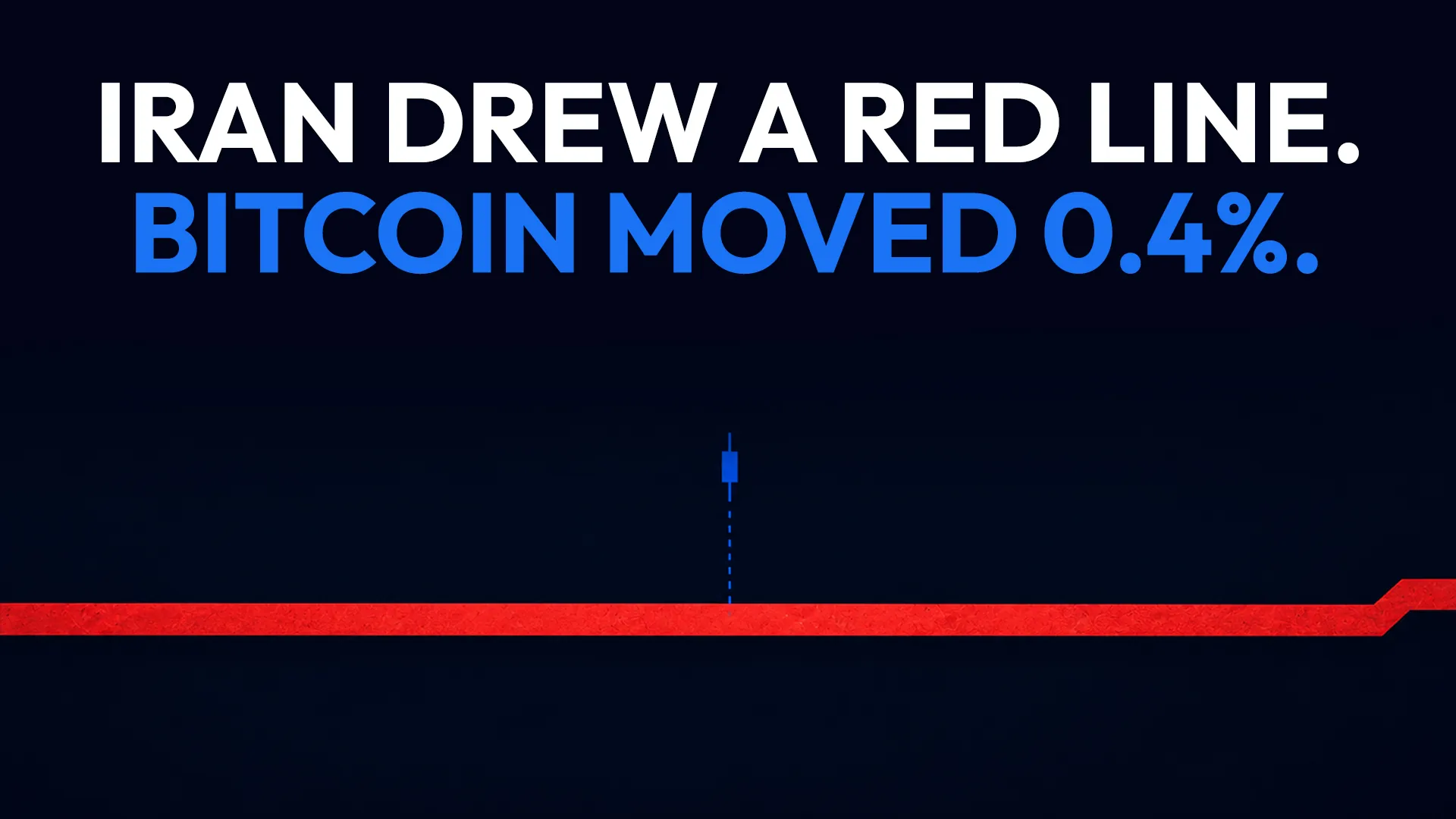
Iranian officials delivered their sharpest Hormuz warning in months this week. Parliament Speaker Mohammad Bagher Ghalibaf stated plainly that in a region where Iran cannot sell oil, no one will sell oil, and that if Iran's security is not ensured, no infrastructure will be safe. Foreign Minister Seyed Abbas Araghchi reinforced the message with a promise of an eye-for-an-eye response to any attack on Iranian infrastructure. The Strait of Hormuz, through which roughly one in five barrels of the world's seaborne oil supply passes, was back at the centre of global market attention. West Texas Intermediate crude gained approximately 2.25% to near US$89 (AU$127.3) per barrel. Brent traded close to US$96 (AU$137.3). Bitcoin fell 0.4% to just below US$66,000 (AU$94,380) before stabilising.
The 0.4% move is the story, not the threat. Iran has made versions of this warning before, during sanctions confrontations in 2011 and 2012, and has never actually closed the Strait. The market knows this. What has changed over the course of 2026 is not the credibility of Iran's threats but the market's learned response to them. Earlier in the year, a Hormuz headline could move Bitcoin several per cent in a session. Now the same category of threat produces a fraction of a per cent move that reverses before the trading day closes. The desensitisation is rational. Traders who positioned aggressively on ceasefire headlines in April and watched the truce collapse within weeks are not repeating that mistake. The geopolitical risk premium has been priced out not because the risk has disappeared but because the market has developed a clearer view of the range of likely outcomes.
The more important signal for Bitcoin this week came not from the Gulf but from the Federal Reserve's implied rate path. The connection between oil prices and Bitcoin runs through inflation. Higher oil pushes consumer prices up, which gives the Fed cover to keep rates elevated, which reduces liquidity for risk assets and, in turn, puts pressure on Bitcoin. The direct oil-to-Bitcoin transmission mechanism is not about energy costs or mining economics. It is about what oil prices signal to the Fed, and what the Fed signals to markets. Iran's threat matters for Bitcoin to the extent it keeps oil above levels that make a rate cut politically difficult. That is a different and more durable concern than whether the Strait actually closes, and it is the one worth tracking through the rest of the quarter.
The US$25 Million Romance Scam Forfeiture
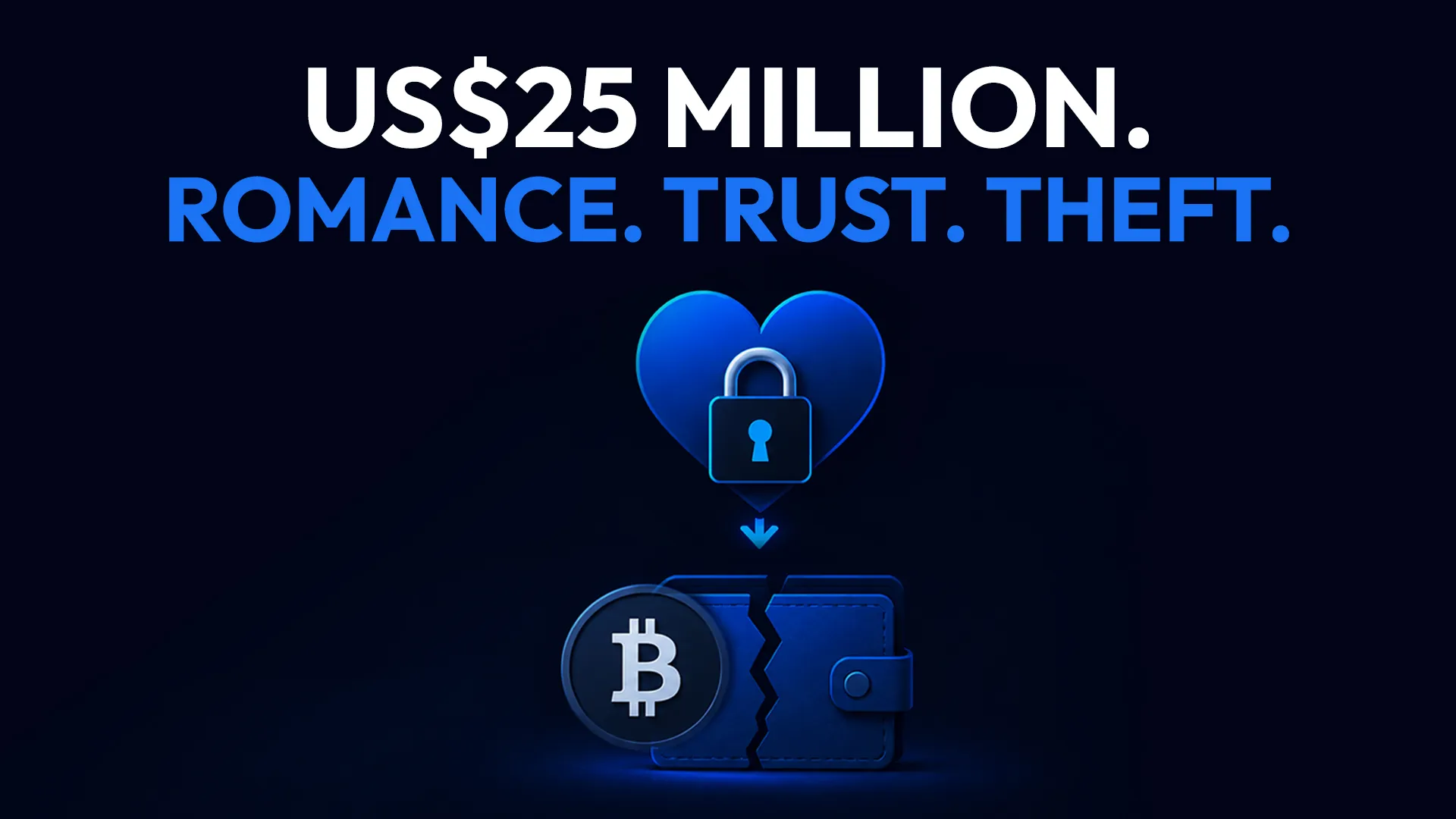
Federal prosecutors filed five civil forfeiture complaints this week seeking more than US$25 million (AU$35.75 million) in cryptocurrency that investigators say was taken from hundreds of real people through romance and investment scams. The two largest cases seek approximately US$12.1 million (AU$17.3 million) tied to online romance schemes and US$10.4 million (AU$14.9 million) linked to fraudulent investment platforms. Three smaller complaints seek a combined US$3.9 million (AU$5.6 million). The funds were traced through hundreds of wallet addresses by Secret Service investigators and linked to more than 270 suspected investment scam transactions and more than 200 romance scam victims, including several in the Washington area. The cases are part of the Scam Centre Strike Force, launched in November 2025, which has now recovered more than US$800 million (AU$1.14 billion) in total.
The mechanics of these scams are worth understanding because they have not changed much even as the amounts have grown. Romance scams typically involve a fraudster building a relationship with a victim over weeks or months before introducing an investment opportunity, often a fake crypto trading platform that shows fabricated returns. When the victim tries to withdraw funds, contact is cut off. Investment scams follow a similar pattern, sometimes targeting people who have already lost money and presenting themselves as recovery services that charge upfront fees. One of this week's cases involved exactly that scenario: a victim who had already been defrauded and was then targeted again by someone claiming they could get the money back. The second fraud exploiting the first is a pattern that recurs throughout this kind of crime.
The human cost behind these numbers is real and worth stating plainly. These are not abstract financial crimes. They are cases where real people were deceived over extended periods by fraudsters who built what felt like genuine relationships before taking everything. The scale of the Scam Centre Strike Force's recovery effort, more than US$800 million (AU$1.14 billion) across its first eight months, reflects both the severity of the problem and the growing capacity of law enforcement to trace crypto transactions in ways that were not possible even five years ago. For Australian users, the practical takeaway is unchanged: any unsolicited investment opportunity arriving through a social platform or messaging app, however convincing the relationship behind it feels, deserves extreme scepticism before a single dollar moves.
Dogecoin at 19-Month Lows. A Whale Bought. Musk Liked a Meme.
Dogecoin is trading around US$0.073 (AU$0.10), its lowest territory since November 2023 and approximately 90% below its 2021 record high. The token has spent 19 months in a sustained downtrend, retracing the entire rally from its December 2024 cycle top near US$0.485 (AU$0.69) back to the base from which that rally launched. Meme coin dominance across the broader market has fallen to a two-year low as capital rotates toward utility tokens, and US spot Dogecoin ETFs, which briefly attracted up to US$2.5 million (AU$3.6 million) in daily inflows in January when DOGE traded around US$0.15 (AU$0.21), have recorded zero net inflows for approximately two weeks. The two existing funds hold a combined US$20 million (AU$28.6 million) in assets, barely above their launch levels.
Two things happened this week that generated attention. On July 19, an unidentified whale purchased 200 million DOGE worth approximately US$14 million (AU$20 million) through Robinhood, pushing futures volume up 114% to around US$740 million (AU$1.06 billion) and lifting open interest above US$1.1 billion (AU$1.57 billion). Around the same time, Elon Musk liked a post on X featuring the Swole Doge meme, reported to be his first Doge-related activity on the platform in months. Speculation about a connection between Musk and the whale purchase circulated widely. No wallet data links Musk to the transaction, and the claim remains unverified.
The honest framing for both events is that they are interesting data points in a market that is looking for reasons to feel better about an asset that has spent a year and a half going the wrong way. A large purchase and a meme like do not change the structural picture: ETF flows are flat, meme coin dominance is falling, and the capital that drove DOGE's previous rallies has largely found other destinations. Whether this week's activity marks the beginning of something or simply a moment of noise in a prolonged downtrend is a question the chart will answer over the coming weeks, not something we are in a position to call. What is clear is that DOGE remains one of the most sentiment-driven assets in crypto, and sentiment right now is being moved by the same forces that have always moved it.
Founder's Corner
The industry feels like it’s holding its breath this week. The Clarity Act (A main topic again, I know right…) has its ethics provision and may or may not have its votes. The window is ten days wide and getting narrower. Whatever happens in the first week of August will matter for Australian crypto holders well beyond American politics, because US regulatory clarity is one of the primary conditions for the institutional capital flows that determine where this market goes next.
The Franklin Templeton paper is a story that interests me. When a firm managing US$1.8 trillion (AU$2.57 trillion) publishes a paper arguing that the on-chain part of the AI trade is the part most investors are missing, that is a signal arriving from traditional finance inward, not from crypto outward. That direction matters. The romance scam forfeiture is the story I want every reader to share with someone they care about. US$800 million (AU$1.14 billion) recovered in eight months tells you something about the scale of what is happening to real people. The answer is not to avoid crypto. It is to use regulated platforms, treat unsolicited investment opportunities with extreme scepticism, and know that the people you are dealing with are who they say they are.
Richard Voice, Co-Founder, Wayex
Things That Made Us Laugh