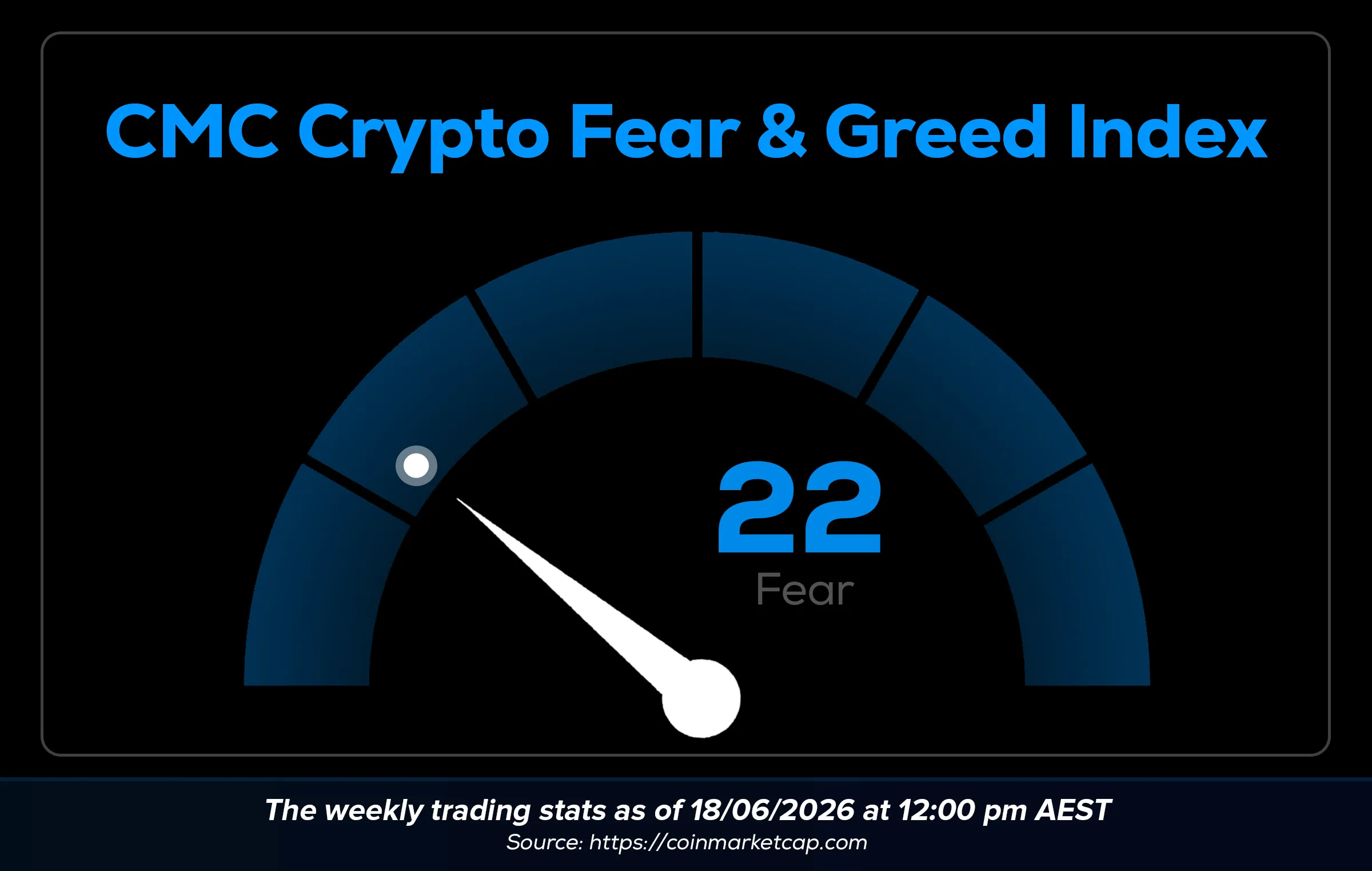
The market found something to celebrate this week. A US-Iran deal reopened the Strait of Hormuz, Bitcoin climbed back above US$65,000 (AU$92,434.61), and some genuinely significant infrastructure moves happened quietly underneath the noise. HYPE hit another all-time high. Coinbase announced tokenised stocks. Ripple planted its flag in Africa. The question worth asking is whether the relief is durable or just another headline waiting to be walked back.
The Deal That Opened the Strait (And Why Bitcoin Only Moved 2%)
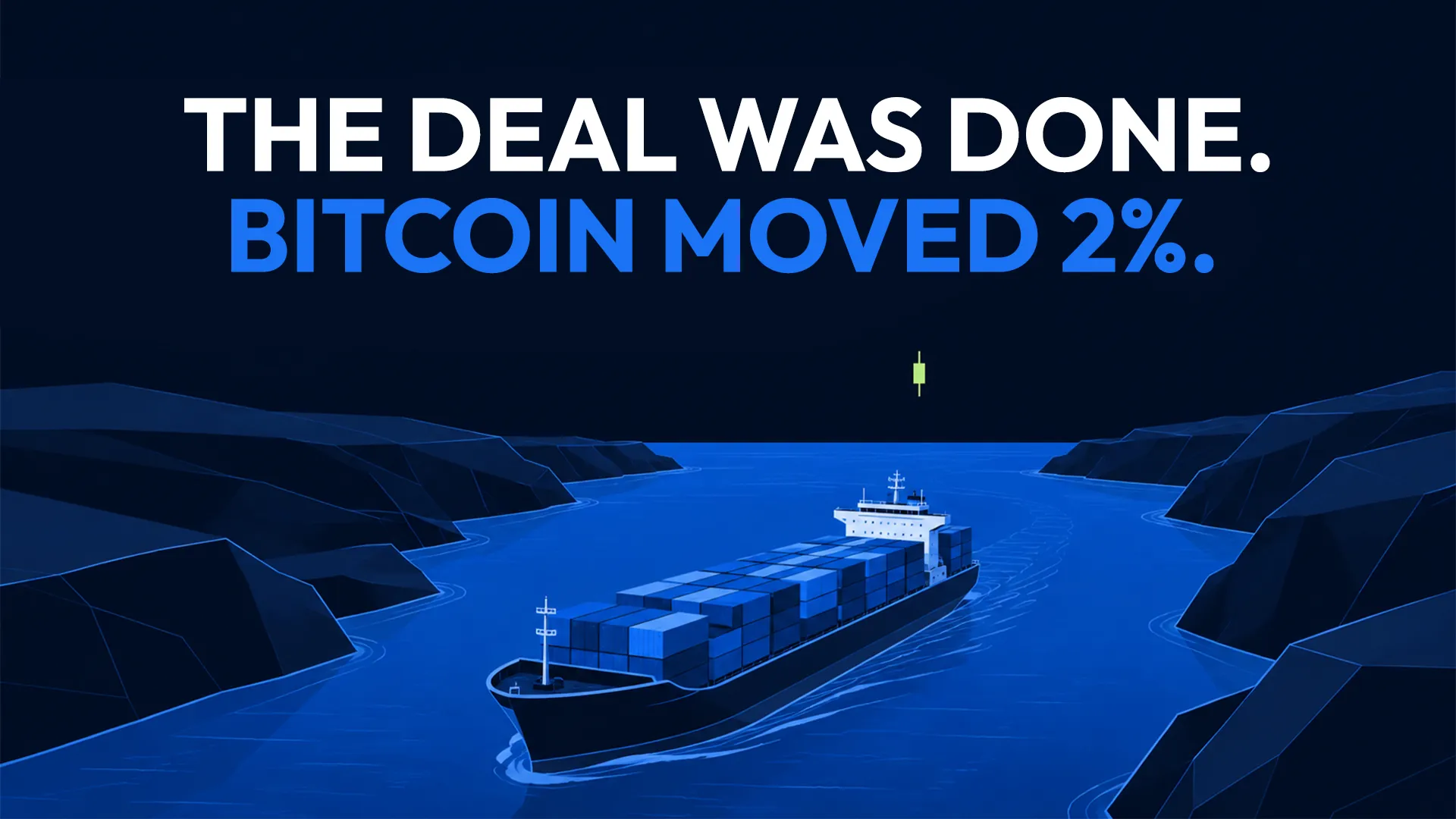
On June 14, President Trump announced on Truth Social that a deal with Iran was complete, the Strait of Hormuz was reopening to toll-free commercial shipping, and the US naval blockade was being lifted. It was the end, on paper, of a four-month conflict that had threatened roughly 20 to 25 per cent of the world's seaborne oil supply. Bitcoin rose 2%, to around US$65,700 (AU$93,430.06). Oil fell harder than Bitcoin rose. By the standard of what the headline announced, the end of a war that had roiled global markets since February, a 2% move is restraint bordering on indifference.
The muted reaction is not pessimism. It is a market that has been trained, painfully and recently, not to trust ceasefire headlines. Count the failures. An April truce extended indefinitely sent Bitcoin surging to US$78,000 (AU$110,921.54) the next day as traders priced out the geopolitical risk premium, and then it collapsed. Trump described the ceasefire in May as being on massive life support. A further pause broke on June 7 when Iran launched missiles toward Israel, US strikes followed on June 9, and through it all, the market kept rallying on peace headlines and surrendering the gains on the next escalation. By the time the June 14 deal arrived, traders had watched the same movie three or four times. They knew the ending.
The June 14 agreement is also thinner than the word done suggests. It is a memorandum of understanding, not a peace treaty. The Strait reopens, and the ceasefire extends by 60 days, but Iran's nuclear program remains unresolved, and no long-term security framework was created. A permanent peace does not come with a two-month expiry date. The market read the document correctly: it priced relief, not resolution. And underlying all of it, the forces that actually govern Bitcoin's price trend, the Federal Reserve's rate stance, ETF flows, and broad liquidity conditions, were not changed by the deal. Removing one of several pressures helps. It does not change the scale. Watch whether the June 19 signing in Switzerland holds and whether the 60-day window passes without a major violation. That is where the real story is, not the announcement.
Japan Hiked to a 30-Year High. Crypto Shrugged.
The Bank of Japan (BoJ) raised its benchmark interest rate to 1% this week in a 7-1 vote, the highest level since 1995 and the latest step in a sustained tightening cycle driven by inflation running above the central bank's 2% target. For anyone who lived through August 2024, when a surprise BoJ hike triggered a yen carry trade unwind that crashed Bitcoin from US$64,000 (AU$91,012.54) to US$49,000 (AU$69,681.48) in 48 hours, the reaction this time was notable for what did not happen. Crypto's total market cap fell just 1.4% on the day. Bitcoin held around US$66,000 (AU$93,856.69). The yen carry trade scare, which had previously been one of the most reliable mechanisms for transmitting Japanese monetary policy into crypto volatility, failed to materialise.
The explanation is not complicated. The Iran relief rally had already moved Bitcoin above US$65,000 (AU$92,434.61) from the low US$60,000s, softening the macro headwind before it arrived. Open interest in Bitcoin futures had eased in the days prior, meaning traders had pulled back from leveraged positions and left little room for a forced unwind. The memory of the 2024 scare was fresh enough that investors refused to repeat the same mistake. Ryan Yoon, senior analyst at Tiger Research, put it plainly: the yen carry trade failed to trigger any meaningful disruption because the market had fully processed that narrative and realised the sky was not falling.
The BoJ also paired its hike with a pledge to step up bond purchases if long-term yields rise sharply, limiting how far the move actually tightened conditions. Japan carries public debt above 200% of GDP, the largest load among advanced economies, and the central bank is threading a needle between normalising rates and not destabilising a market that has depended on cheap yen for decades. For crypto, the honest takeaway is that a rate hike is just another headline once the market has already priced it in and cleared the leverage that would have amplified the impact. The scare loses its power to move prices once enough people have survived the last one.
HYPE Hits Another All-Time High. Here's Why.
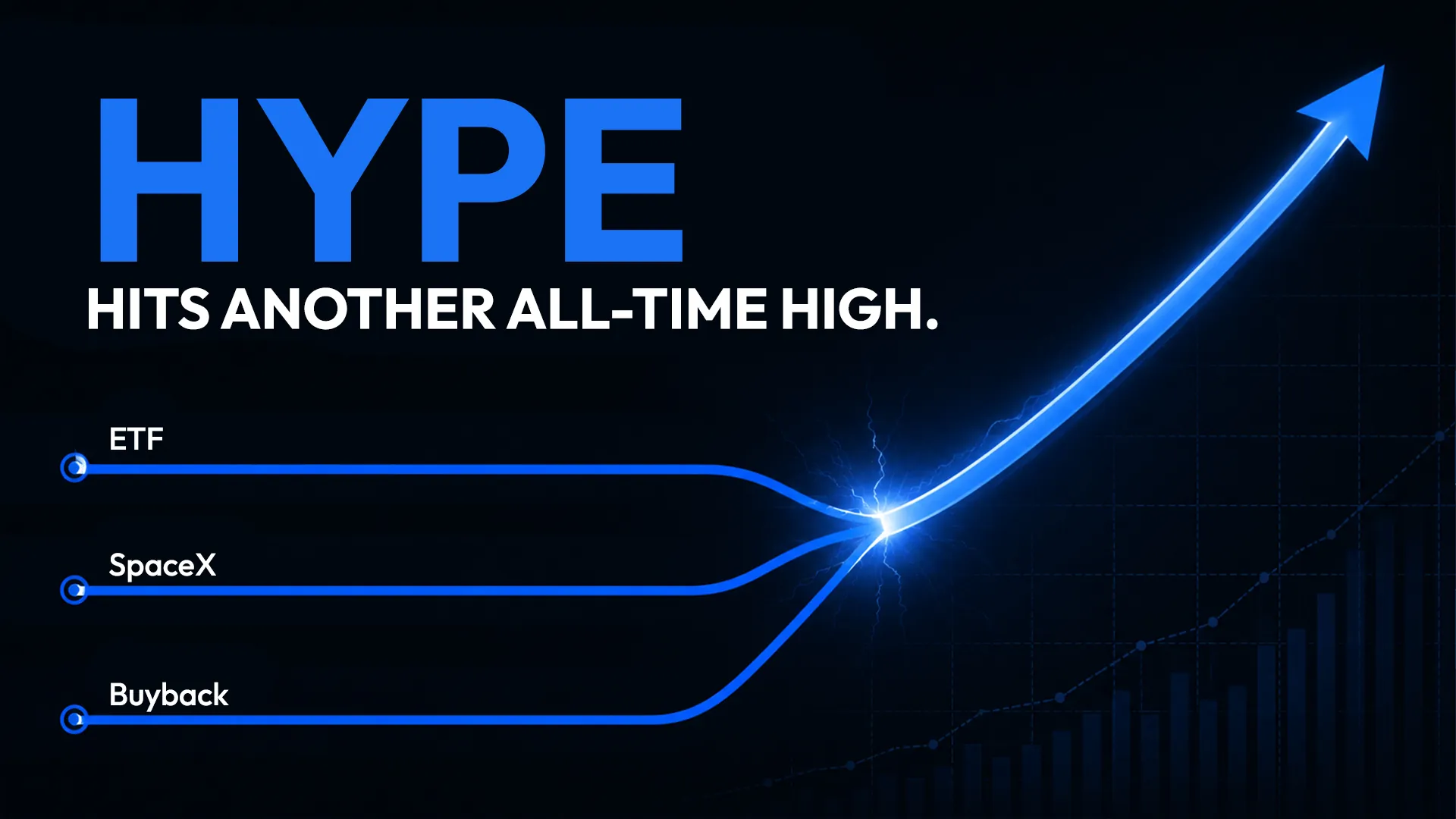
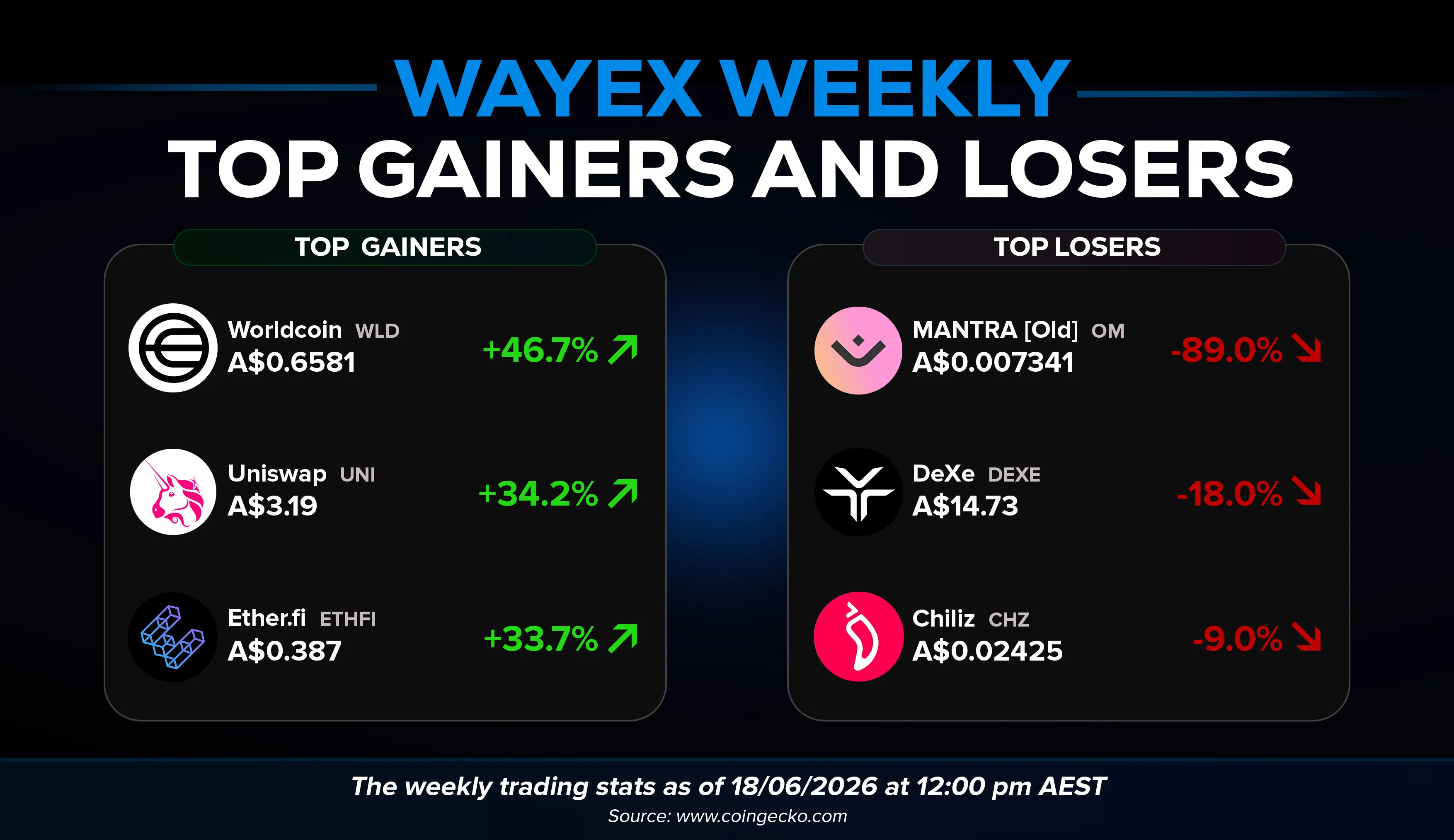
Hyperliquid's HYPE token reached a new all-time high of US$76.70 (AU$109.07) this week, up roughly 46% over seven days and more than 90% over the past month. The move drew attention partly because it happened while most of the market was still recovering from three consecutive weeks of losses, but the more interesting story is the mechanics behind it, because this is not a rally built on sentiment alone. Three distinct forces converged to push HYPE through resistance levels and into record territory, and each of them reflects something real about the platform's growth.
The first was direct ETF buying. Bitwise purchased approximately 77,100 HYPE tokens worth around US$5.2 million (AU$7.39 million) to support its newly launched Bitwise Hyperliquid ETF, adding fresh spot demand into a market where supply has been steadily reduced by the protocol's own buyback mechanism. Hyperliquid directs 97% of its trading fees toward purchasing and burning HYPE, creating persistent demand that compounds as platform activity grows. The second force was SpaceX. Hyperliquid's pre-IPO SpaceX perpetual futures contract generated roughly US$1.2 billion (AU$1.71 billion) in trading volume during the past week alone, attracting substantial trader interest and helping push Hyperliquid's share of global perpetual futures open interest to approximately 8.3%, with total open interest climbing above US$9.6 billion (AU$13.65 billion).
The third force was a short squeeze. As HYPE moved through key resistance levels, traders holding leveraged bearish positions were forced to cover, accelerating the rally toward its record high. A scheduled token unlock earlier this month that released roughly US$700 million (AU$995.45 billion) worth of HYPE into circulation had the potential to create sustained selling pressure, but demand generated by exchange activity and protocol buybacks proved sufficient to absorb it. The picture that emerges is of a platform capturing real market share, generating real revenue, and returning it to token holders in a way that creates structural support for the price. Annualised protocol revenue has now exceeded US$1 billion (AU$1.42 billion). That is not a speculative number. It is a business metric.
Coinbase Wants to Be Your Everything Exchange
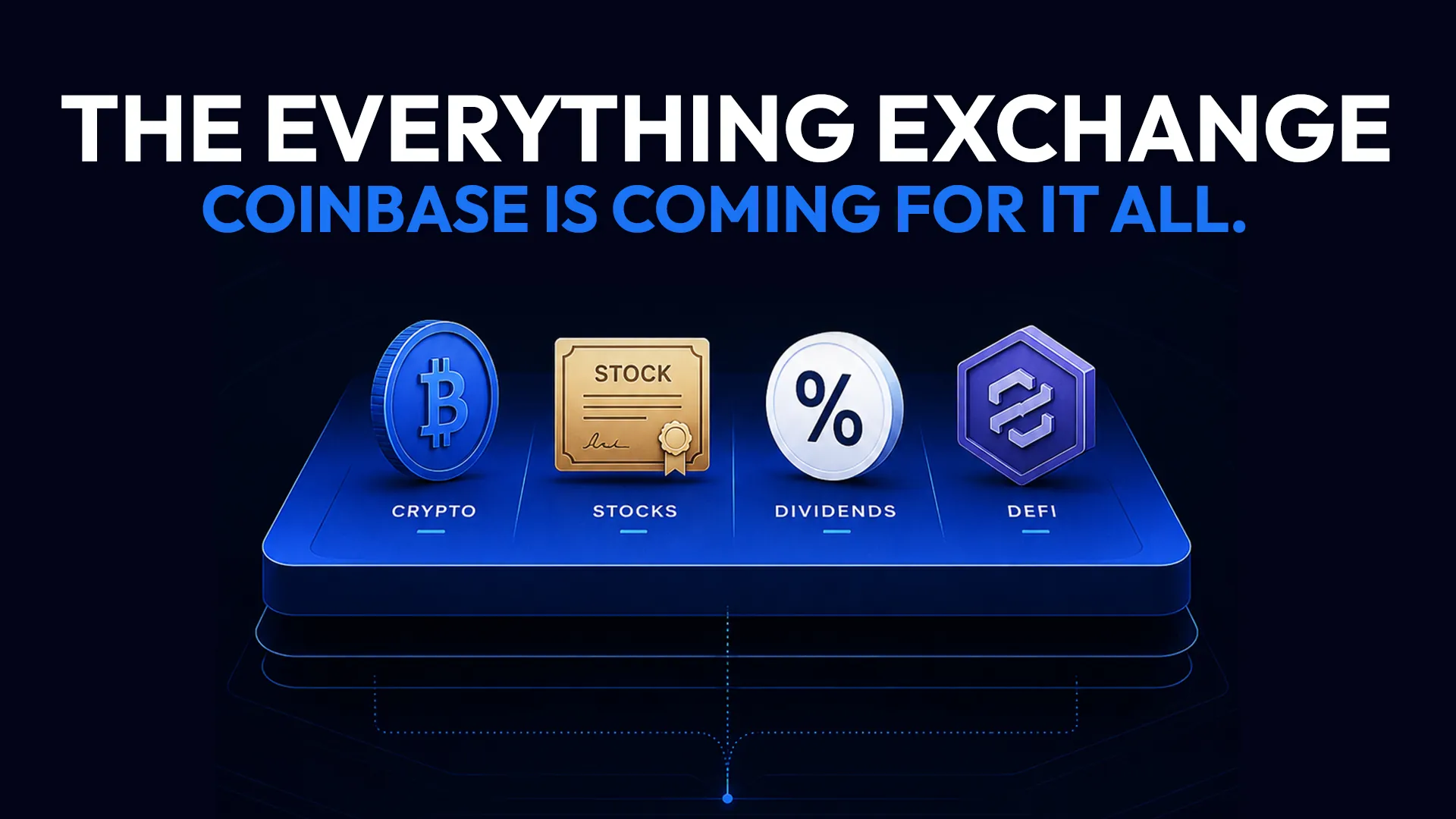
Coinbase announced this week that it is launching tokenised US stocks backed one-for-one by the underlying equities, with automatic dividend payments distributed through smart contracts and no derivatives or IOUs involved. CEO Brian Armstrong has been publicly championing the vision of an everything exchange for months, a single platform handling crypto, stocks, options, and tokenised real-world assets under one roof. The tokenised stock announcement is the most significant step yet toward that vision, and the race it has triggered among major exchanges is worth paying attention to.
The distinction Coinbase is drawing matters. Most existing tokenised stock products from exchanges, including Binance, OKX, and Hyperliquid, give non-US investors exposure to stock price performance through derivatives without holding the underlying shares. Coinbase is promising actual ownership: real shares in reserve backing every token one-for-one, with dividends flowing automatically and tokens living on-chain where they can interact with the broader decentralised finance ecosystem. The groundwork was already in place. Earlier in 2026, Coinbase launched conventional US stock trading with zero commissions and 24/5 access and built out its Coinbase Tokenise platform targeting institutional players looking to bring real-world assets on-chain. The tokenised stock product is the next logical step in that architecture.
Kraken has pushed tokenised US stocks through its xStocks product, Robinhood has outlined plans for tokenised equities in Europe, and firms including BlackRock, Franklin Templeton, and JPMorgan have expanded tokenised fund products. The race is crowding fast. For Australian users, the practical relevance is immediate: Coinbase confirmed the rollout will begin in eligible jurisdictions outside the United States, meaning Australian investors could be among the first to access 1:1 backed tokenised US equities through a crypto-native platform. The convergence of crypto and traditional equity markets is no longer a future state. It is a product announcement with a coming soon date attached.
Ripple Goes to Africa
Ripple invested in Flutterwave's Series E funding round this week, valuing the African payments company at US$3.2 billion (AU$4.55 billion) and embedding Ripple's RLUSD stablecoin and the XRP Ledger directly into Flutterwave's payment infrastructure across 34 African markets. The financial terms of Ripple's stake were not disclosed, but the strategic intent was stated plainly: to replace the correspondent banking networks that have long dominated cross-border transactions on the continent with faster, cheaper, stablecoin-powered settlement rails. For a region where remittances and cross-border commerce play a central role in the economy, the pitch is not abstract. Multi-day settlement delays and elevated foreign exchange margins are real costs that real businesses absorb every day.
Flutterwave is not a speculative bet. The company has processed over one billion transactions worth more than US$50 billion (AU$71.10 billion) and operates one of the most advanced payments networks on the continent. Its Send App remittance product will integrate RLUSD as a primary settlement asset for high-volume corridors, with the XRP Ledger handling transaction clearing and a unified API connecting Flutterwave's domestic network with Ripple Payments, Ripple's global transfer network operating across more than 90 markets. The deal formalises a strategic direction Flutterwave had been signalling for some time, and it positions both companies at the centre of Africa's emerging stablecoin economy at a moment when that economy is moving quickly.
The Australian angle is worth noting. Ripple is in the final stages of acquiring BC Payments Australia to obtain an Australian Financial Services Licence, expanded its Major Payment Institution licence in Singapore in late 2025, and joined the central bank-backed BLOOM initiative in March 2026 to pilot tokenised bank liabilities and RLUSD trade flows. The Flutterwave deal is not an isolated move. It is one piece of a deliberate global infrastructure expansion that includes Australia. RLUSD currently has a US$1.6 billion (AU$2.28 billion) supply, growing more than 20% this year. The stablecoin rails are being laid. The question is which platforms and which corridors get built on top of them first.
One Man, Briefly Richer Than Bitcoin
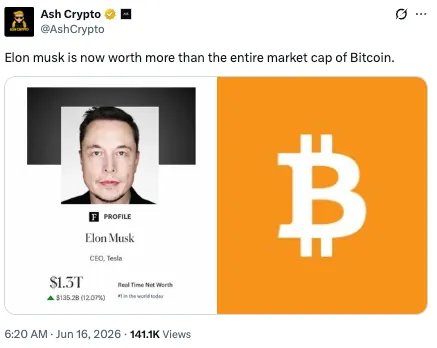
On June 16, SpaceX shares hit an intraday high of US$225.84 (AU$321.16), roughly 67% above the company's US$135 IPO price, briefly pushing Elon Musk's net worth to nearly US$1.4 trillion (AU$1.99 trillion) and past Bitcoin's market capitalisation at the time. It lasted about as long as a ceasefire headline. Shares pulled back before the close, Musk's paper wealth retreated with them, and Bitcoin's market cap reasserted its position as the larger number. The milestone was real for a moment, which was apparently long enough to start a political argument.
Senator Elizabeth Warren used the occasion to renew her push for a wealth tax, arguing that a system allowing one person to become a trillionaire while millions cannot afford basic healthcare is structurally rigged. Solana co-founder Anatoly Yakovenko pushed back on X, making the case that forcing Musk to sell shares would reduce investment, slow hiring, and ultimately hurt the workers and shareholders building SpaceX in Texas. The debate is a familiar one, and it will not be resolved in a social media thread. What it does is illustrate a tension that sits underneath a lot of the conversations about crypto, AI, and concentrated wealth right now: the gap between paper gains and taxable income, and who decides when one becomes the other.
Crypto analyst Scott Melker offered the most entertaining contribution to the week's discourse, posting that the fastest path to a US$1 million (AU$1.42 million) Bitcoin is convincing Elon Musk to put 10% of his net worth into BTC. The maths is not entirely wrong. Whether Musk's attention ever returns to Bitcoin after his current SpaceX moment is a different question, and one the market will be watching with the same mixture of optimism and scepticism that tends to follow anything with his name attached.
Founder’s Corner
This week felt different to the ones that came before it. Not dramatically so, but noticeably. The market found something to be cautiously optimistic about, there was a 50/50 mix of positive and negative news. It was good to see that Bitcoin climbed back above the US$65,000 mark. The relief was real. Whether it lasts is the question nobody can answer honestly yet.
The story I keep coming back to is not the Iran deal or the HYPE all-time high. It is Coinbase and Ripple, two very different companies making very similar bets in the same week. Coinbase is building toward an everything exchange, bringing tokenised stocks onto the same platform as crypto with real ownership and real dividends. Ripple is embedding its stablecoin into Africa's largest payments network, building settlement rails for a billion dollars' worth of real commerce. Neither of those announcements got the attention the price charts did. Both of them matter more.
There is a version of this industry that wins by being louder, more speculative, and more politically connected than everything around it. There is another version that wins by being more useful, more accessible, and more trustworthy than the financial infrastructure it is replacing. The week's quieter stories point toward the second version. That is the version worth building for, and the version Wayex is oriented around. Regulated, compliant, and here for what comes after the noise settles.
Richard Voice, Co-Founder, Wayex
Things That Made Us Laugh