USDC vs USDT in 2026: which dollar stablecoin should you actually hold?
For about five years the answer to "USDC or USDT?" was tribal. If you were a DeFi user with institutional leanings, you held USDC. If you were in emerging markets or trading on international exchanges, you held USDT. Neither side was wrong and the conversation rarely got further than that.
In March 2026, USDC's on-chain volume passed USDT's for the first time since 2019. Circle's IPO a year earlier changed the reporting cadence and quality of Circle's disclosures, and it turns out transparency is popular. Meanwhile Tether's pivot onto its own chain, Plasma, has sucked a chunk of its volume into a walled garden that does not show up in the same metrics. Both of those effects are real, and neither is the only thing going on.
The question for most normal people is not which stablecoin is going to "win." It is which one makes more sense for your specific situation. The answer depends on three things: where you live, what you are trying to do with the money, and how much you care about the details of issuer risk.
The one-paragraph summary
USDC is safer on paper, cleaner to report, and better supported in U.S. regulatory contexts. USDT has more liquidity, more exchange pairs, and is the de-facto dollar in most of Africa, Latin America and Southeast Asia. For holding and spending, USDC is the conservative pick. For cashing in and out through local OTC markets, USDT wins almost everywhere outside the U.S. and Europe. If you can hold both, hold both.
That is the short version. Below is why.
Backing and audits
USDC is issued by Circle. Its reserves are held at BlackRock, BNY Mellon and a handful of other institutional custodians, almost entirely in U.S. Treasuries and cash. Circle publishes monthly attestations from Deloitte and files full financial statements with the SEC after its 2025 IPO. You can walk through the balance sheet line by line if you want.
USDT is issued by Tether Limited. Its reserves are held at a mix of banks and custodians that Tether has been incrementally more transparent about since the 2021 settlement with the New York Attorney General. The reserves are mostly in U.S. Treasuries and cash equivalents, with a smaller allocation to secured loans, corporate bonds and bitcoin. Tether publishes quarterly attestations from BDO Italia. The peg has held through every major crisis since Tether launched — 2018, 2020, the Terra collapse in 2022, the SVB weekend in 2023, and 2024's banking tremors. It has never, to date, failed to process a redemption from a verified counterparty.
PYUSD is backed by cash and Treasuries, custody at Paxos, audited by WithumSmith+Brown. Smaller float, cleaner profile, but the distribution is mostly limited to PayPal and Venmo flows, which is why it matters less in a general-audience conversation.
DAI is over-collateralized by other crypto assets managed by the MakerDAO protocol. It is the least exposed to a single issuer and the most exposed to smart-contract and collateral-design risk. A valuable part of the ecosystem but not a straightforward like-for-like alternative to USDC or USDT for most normal use cases.
Regulation and jurisdictional fit
The GENIUS Act, which the OCC is now implementing rules for under Bulletin 2026-3, effectively treats payment stablecoins issued by regulated U.S. entities as something close to bank deposits in a restricted form. USDC and PYUSD clearly qualify. USDT does not issue from a U.S. entity and therefore operates under a different regime. Practically, this means U.S. fintechs and U.S.-licensed card programs will lean heavily toward USDC and PYUSD for the next few years, because their compliance and banking partners prefer it.
MiCA in the European Union imposes similar-but-not-identical constraints. USDC obtained its MiCA licenses in 2024. USDT has not, which is why large European exchanges have quietly delisted or restricted USDT trading pairs for retail users in the EU. If you are in France, Germany, Italy or Spain, USDC is the cleaner hold.
Outside the U.S. and EU, the regulatory picture is more fragmented and USDT's ubiquity works in its favor. Nigeria, Argentina, Turkey, the Philippines — USDT is simply the easier coin to buy from a human being for local cash, and the easier coin to sell back to a human being for local cash. That is a real advantage and worth paying attention to if your life touches any of those markets.
Liquidity and spread
On major exchanges the bid-ask spread for USDC and USDT is effectively identical. The difference shows up in the long tail of venues. USDT-settled exchanges tend to have marginally tighter USDT pairs, because USDT is the settlement asset; USDC-settled venues are the mirror image. On decentralized exchanges the gap has closed over the past two years, with USDC narrowly leading in Ethereum mainnet volume and USDT leading on BNB Chain and Tron. If you are doing a transaction larger than ten thousand dollars at a time, check the specific pair you need rather than relying on a general rule.
Chain support
USDC is natively issued on Ethereum, Solana, Polygon, Avalanche, Arbitrum, Optimism, Base, Stellar, Algorand, Near, Noble (Cosmos) and a handful of others, with Circle's Cross-Chain Transfer Protocol handling moves between them cleanly. USDT is natively issued on Ethereum, Tron, Solana, Avalanche, and now Plasma — its own chain. On Tron, USDT is the dominant asset and transaction fees are a fraction of what they are on Ethereum, which is the single biggest reason USDT dominates remittance and OTC flows in emerging markets. If you are optimizing for low gas costs on transfers, USDT on Tron is hard to beat. If you are optimizing for where DeFi protocols and regulated institutions want to meet you, USDC on Ethereum or Base is the default.
For spending — which one to deposit on your Wayex card
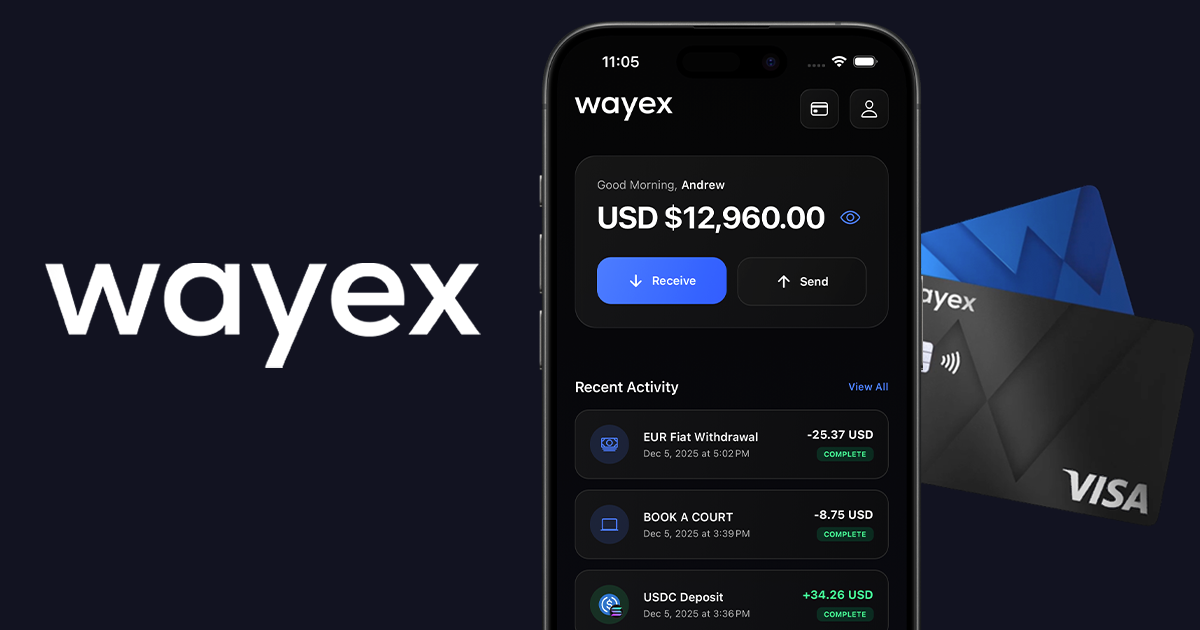
Honest answer: it does not matter to the card. Wayex converts whatever stablecoin you deposit — USDC, USDT, DAI or PYUSD — into a single USD balance the moment it arrives. From the card's perspective, the only thing that exists is that unified USD balance. You do not pick a coin at checkout. You do not pick a chain at checkout. The card just spends USD.
The question is therefore not "which stablecoin should I hold in my card account," but "which stablecoin is cheapest and easiest for me to send in." If you are getting paid in USDC — because your client is U.S.-based or uses a Stripe-style payout rail — deposit USDC. If you are getting paid in USDT — because your client is overseas and USDT-on-Tron is the cheapest way for them to pay you — deposit USDT. Converting between the two on-chain before depositing costs you real fees for zero benefit. Push whichever one you received; Wayex handles the rest.
The boring conclusion
Most arguments about USDC versus USDT are proxy arguments about regulation, ideology, or where your life is based. Both are viable dollar substitutes for almost every normal use case. If you live in the U.S. or EU, default to USDC. If you live in LATAM, Africa, or most of Southeast Asia, USDT's liquidity probably touches your life in ways USDC does not. On Wayex, the choice essentially disappears after deposit — whatever you send in becomes USD in your account, and the card spends USD. USDC vs USDT becomes a question about how your money got in, not what happens when you spend.