Global USD accounts, explained — how you can hold and receive dollars without a US bank
If you live outside the United States and your work touches the dollar — a freelance client in California, a software contract in New York, a family member sending remittances from Texas — the question "how do I receive and hold US dollars" used to be surprisingly hard. Opening a US bank account from abroad required either physical presence, a US tax identification number, or a long paper trail that most banks did not want to process. Wire transfers were expensive. Intermediary services took a visible cut.
Over the last five years the answer has quietly improved. "Global USD accounts" — sometimes called virtual dollar accounts, USD receiving accounts, or multi-currency accounts — have become a normal product offering from fintech providers worldwide. This piece explains what they actually are, how the plumbing works, and what to look for when choosing one.
What a global USD account actually is
A global USD account, in the most practical sense, is a set of US bank routing details (a routing number and account number, or sometimes a SWIFT code for international wires) issued in your name by a fintech provider that partners with a US bank. The US bank is the legal account holder; the fintech is the customer-facing interface. When someone in the US sends you an ACH transfer or a domestic wire, the money arrives at the partner bank and is credited to your account in the fintech's system.
To the sender, it looks like a normal US bank account. To you, it looks like a line in your app. You did not have to fly to the US, you did not have to provide a US tax ID, you did not have to negotiate with a branch manager.
A growing share of global USD accounts also include stablecoin deposit support. You can send USDC, USDT, DAI or PYUSD on any supported blockchain to the account, and the stablecoin converts to a USD balance inside the fintech on arrival. From that balance, you can do the same things you would do with a bank deposit — hold it, send it somewhere else, spend from a linked card.
Why the stablecoin layer matters
Traditional global USD accounts offered by incumbents are genuinely useful but limited by the banking system they sit on top of. They receive ACH and wire, they let you spend, they let you off-ramp to your local currency — all through the normal correspondent banking network. That network is slow (ACH takes one to two business days), expensive at the high end (wires cost twenty to fifty dollars and take one to three days), and sometimes geographically patchy (sending from the US to a provider in Latin America or Africa can hit unexpected friction).
Stablecoin rails sit alongside those traditional rails and often replace them for specific flows. A USDC transfer settles in seconds for cents. A USDT on Tron transfer is effectively free. If your US client is willing and able to pay in stablecoins — increasingly common via Deel, Upwork, Fiverr, or direct invoicing — you skip the banking layer entirely.
A modern global USD account can take both. An ACH transfer arrives, it credits a USD balance. A USDC transfer arrives, it credits the same USD balance. From the account's perspective these are different deposit rails landing in the same pool.
Five things to check before choosing one
1. Who actually holds the money. Ask who the underlying bank is, and whether deposits are FDIC-insured at that bank. A fintech with a real bank partner and regulatory clarity around deposit insurance is different from one with offshore custody and less clear guarantees. This matters more than marketing about "security."
2. What deposit rails are supported. ACH and domestic wire are the baseline. International wires (SWIFT) matter if you send or receive larger sums. SEPA for EUR, PIX for BRL, SPEI for MXN are valuable if you operate across those corridors. Stablecoin support (USDC, USDT, DAI, PYUSD) and the chains supported (Ethereum, Solana, Polygon, Base, Arbitrum, Optimism) matter if you receive crypto-denominated income.
3. What the fees look like. Some providers charge zero to receive ACH and a small fee on wires. Some charge by size. Some charge nothing to hold but take a spread on conversion. Read all of these before opening the account.
4. How money leaves. A global USD account is only useful if you can spend or withdraw from it. Check for: a linked debit card (the most flexible), local bank withdrawal rails (PIX, SPEI, SEPA), international wire support, and stablecoin withdrawal options. The more rails, the more optionality.
5. Where the provider is available. Some global USD account offerings are restricted by the user's country of residence. Others are available in 160+ countries but still vary in feature availability (some countries get card, some do not). Confirm the full feature set works where you live before signing up.
A note on taxes
In most jurisdictions, holding a global USD account does not change your tax obligations — you still owe income tax on the income, wherever it is denominated. What does change is how easy it is to receive, hold and spend that income without converting to local currency at the moment of each paycheck. That time-arbitrage is usually where the benefit compounds.
Depending on your country, there may be reporting requirements for foreign-denominated accounts above certain thresholds. Talk to an accountant who knows your local rules. This is not tax advice.
Where Wayex fits
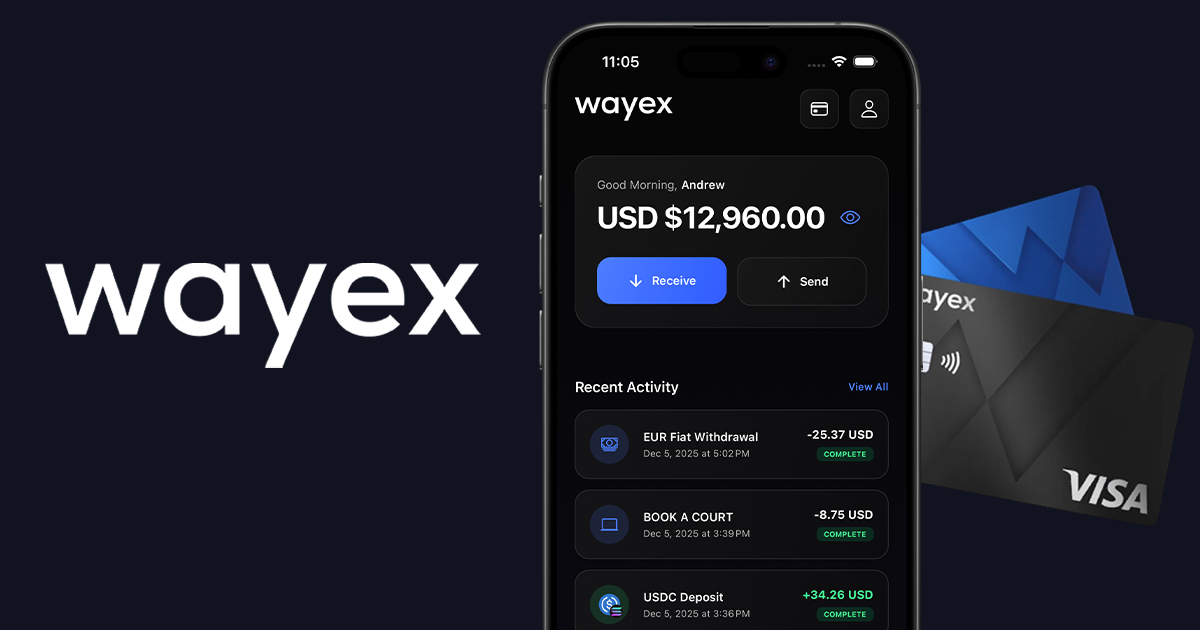
Wayex offers a global USD account with ACH and wire for USD, SEPA for EUR, Faster Payments for GBP, PIX for BRL, and SPEI for MXN. All deposit rails — including stablecoin deposits in USDC, USDT, DAI or PYUSD on 10+ blockchains — credit a single unified USD balance. That balance funds the Wayex Visa debit card, or you can send it out through any of the supported rails. The account is available from 160+ countries for KYC and stablecoin deposits; card issuance is live in 28 markets and expanding.
If you work across borders, a global USD account is one of the highest-leverage pieces of financial plumbing you can set up. It does not replace a local bank account — you still need one of those for day-to-day life — but it gives you a parallel dollar rail that most ordinary banks cannot.