How freelancers actually get paid in USDC in 2026 — Upwork, Deel, Fiverr and direct invoices
Three years ago, telling a client you wanted to be paid in stablecoins was a conversation. Today it is a checkbox. The three biggest freelance platforms all support USDC payouts natively now, Deel added it in 2024 as part of its BVNK partnership, Upwork followed in 2025, Fiverr in early 2026. The real change is that the friction has moved from the payment itself to the surrounding infrastructure — how you receive it, where you hold it, and what you do with it when your rent is due in pesos or reais or naira.
This guide is practical. No lectures on "the future of work." Just what actually works right now, in the places most of our users live.
The three flows you will actually use
There is a direct-invoice flow, a platform flow, and an employer-of-record flow, and they are different enough that it is worth separating them.
Direct invoice. You send your client an invoice, they pay it. If your client is crypto-native, they wire USDC directly to a wallet address you control. If they are not, they probably want to pay by ACH or SWIFT and let a service like Request Finance or Bitwave convert on the back end. Either way, the money ends up in a wallet you control. Fees are effectively zero on-chain. Settlement is instant on Solana, Base, Polygon, and Arbitrum; a few minutes on Ethereum. This is the best-case flow and also the one that requires the most trust between you and the client.
Platform flow. You work through Upwork, Fiverr, Contra, or any of a dozen marketplaces. The platform holds your escrow balance, the client releases funds, and you choose a payout method. USDC is now available as a payout method on every major platform. Upwork's implementation goes through Circle directly and settles in about fifteen minutes. Fiverr uses BVNK. Contra and MasterClass-type platforms vary. Fees vary too — Upwork charges $0.99 flat for USDC payouts, which is materially better than the $1.99 Wire or $0 ACH (the $0 ACH loses you a day and ties you to a U.S. bank account). If you live outside the U.S. and do not have a U.S. bank, USDC is usually the cheapest payout option the platform offers.
Employer-of-record. You are contracting through Deel, Remote, Papaya, Oyster, or one of the similar platforms that handles the compliance and payroll side for the client. These platforms have added stablecoin payouts specifically because a large share of their user base is in countries where the local banking system makes dollar payout slow and expensive. Deel's integration with BVNK lets you elect a USDC payout that arrives within an hour, flat fee of about $1.50 regardless of size. That is dramatically cheaper than a SWIFT wire to most emerging markets.
Where you actually want the money to land
Getting paid in USDC is only the first half of the problem. The second half is what you do with it.
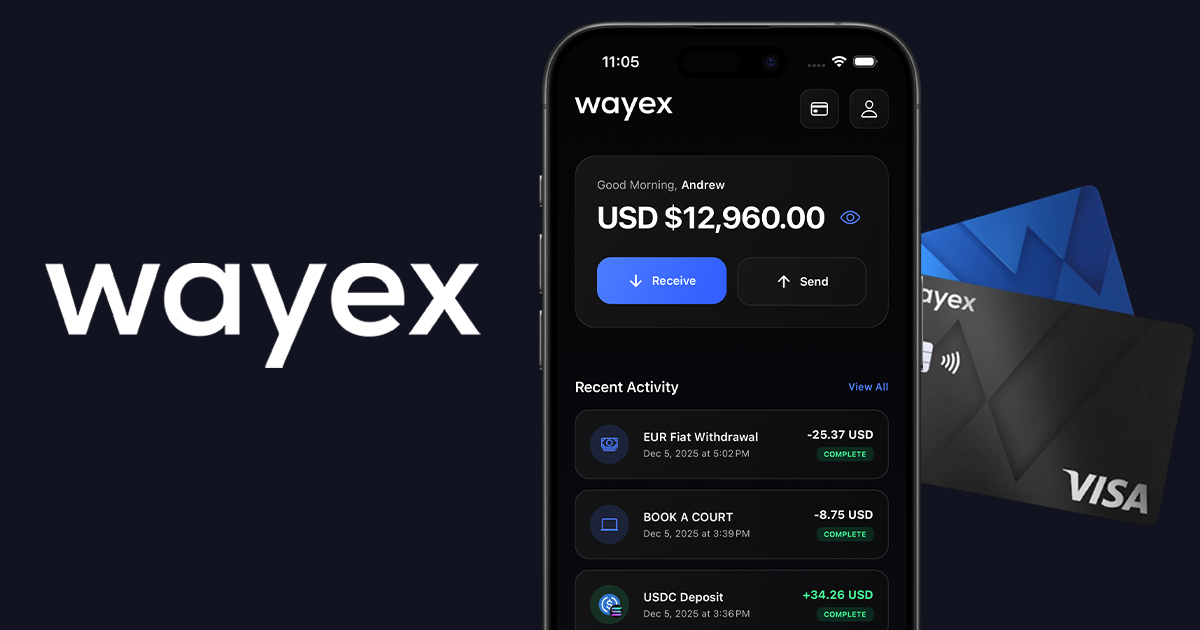
If you are in the U.S. or EU and your main financial life is in dollars or euros, you probably want to treat USDC like a high-yield checking account. Hold it, spend it from the Wayex card for day-to-day, and keep a cushion. Easy.
If you are in Argentina, Brazil, Nigeria, Turkey, the Philippines, Colombia, Mexico — any market with either inflation, a devaluing local currency, or restrictive capital controls — the calculus is different. The whole point of getting paid in USDC is that it is a dollar you control. Converting it to local currency right away defeats the purpose. The right approach for most people in these countries is to hold the balance in USDC, spend directly from a stablecoin card for anything that accepts Visa (which is almost everything), and only convert to local currency for the bits of life that actually require it — rent, groceries, utilities.
This is why stablecoin cards and global USD accounts became a category at the same time as stablecoin payroll. They solve adjacent problems. The payroll platform pays you in USDC. The global account gives you somewhere to receive wires or ACH transfers in dollars if that is what your client prefers. The card lets you spend the balance without a round trip through the local banking system. Together, they replace the layer of ten-year-old friction that made the whole "get paid in dollars while living abroad" thing a pain in the first place.
Corridor-specific notes
Argentina. USDC and USDT are both effectively dollars. Local OTC rates on USDT are typically marginally better through registered crypto exchanges and P2P desks, but for day-to-day card spending it does not matter which you hold. Keep a small pesos buffer for government and utility payments that do not accept cards, and spend dollars for everything else.
Brazil. PIX integration with USDC went live in 2026. If your client pays you in USDC, you can convert to reais via PIX inside Wayex or comparable products, and the rate is close to the mid-market. Cartão spending works at 0 percent USD and 1.5 percent FX on reais-denominated merchants, which is considerably better than most local bank debit cards charge on foreign-currency purchases.
Nigeria. USDT has more liquidity on local P2P desks, but for a stablecoin card, USDC or USDT works identically. The real question in Nigeria is how you get the USDC or USDT on-chain in the first place — direct payment from an overseas client is the cleanest path; P2P purchase is the most common for freelancers starting out.
Philippines. GCash added USDC integration in 2025, which makes the on-ramp and off-ramp locally much easier than it used to be. For OFWs in particular, the ability to receive a USDC payment from abroad and either spend it on a card or convert to pesos via GCash is a meaningful cost reduction versus wire remittances.
Mexico. SPEI integration with USDC went live in 2024 through Circle partnerships with local regulated infrastructure. If you are receiving USDC from a U.S. client, you can push it to a local bank account via SPEI inside Wayex with minimal fees. Many Mexican freelancers now run their entire income through USDC, keeping a pesos buffer for utilities only.
One tax note, and then we stop
Depending on where you live, getting paid in stablecoins is either exactly the same as getting paid in dollars for tax purposes, or it is slightly different and you need an accountant who knows what they are doing. In the United States, the IRS has not issued specific guidance that changes the rules — you owe income tax on the dollar value at the time you received it, and you owe capital gains only if the stablecoin's value diverges from $1 between receipt and spend, which for USDC and USDT in practice means effectively never. In most of LATAM, Africa, and Southeast Asia, the guidance is similar in spirit, and the practical enforcement depends on whether your local tax authority is looking.
Talk to an actual accountant for your specific jurisdiction. This is not that article.
The bottom line
If you freelance internationally, being paid in USDC in 2026 is not a hack. It is a supported, documented feature of every major platform you already use. The harder problem — spending, converting, holding without losing purchasing power — is what Wayex and comparable products solve. Combined, the playbook is: invoice in USDC, receive in USDC, hold in USDC, spend from a card for 80 percent of your life, convert to local currency for the other 20. It is quieter than the 2021 crypto-bro version of this pitch, and that is why it is finally working.